
Nectar 4 and Neutron 5 do different jobs and share only three modules: EQ, Compressor and Gate. Buy Nectar 4 Standard if vocals or dialogue are the job, because it has the de-esser, pitch correction, reverb, delay and doubling that Neutron lacks. Buy Neutron 5 if you mix whole songs, because its Clipper, Density, Transient Shaper, Unmask and Visual Mixer work on every track. You need both only for full productions with vocals in them, and then a crossgrade or the iZotope Plus subscription is the cheap way in.
My logic is to buy for the job the other suite can't do. If you mostly record and mix voice, I'd buy Nectar Standard first, because a de-esser, pitch correction and a reverb are jobs Neutron simply doesn't have, while its EQ, compressor and gate are already inside Nectar. For full songs I'd buy Neutron, because Clipper, Density, Transient Shaper and Unmask earn their keep on drums, bass and buses, not just on the vocal.
Nectar or Neutron: the short answer
Pick by the material you mix most, not by the feature count. The US iZotope store listed these prices on October 23, 2026, with no sale running:
- Vocals, podcasts, voice-over: Nectar 4 Standard, $199.
- Whole songs, beats, band mixes: Neutron 5, $299.
- Both: the iZotope Plus subscription at $150 a year, or Nectar Standard plus the $199 Neutron crossgrade.
Both are current products, and neither has been folded into the other. Nectar 4 went on sale in September 2023, and its 4.2.0 update arrived on August 18, 2026, according to iZotope's Nectar release notes. Neutron 5 launched on October 28, 2024 and reached version 5.2.0 on February 4, 2026, a maintenance release listed in the Neutron release notes. Both families sit in our iZotope plugin guide, next to RX and Ozone.
What each one has, and the three modules they share
Only EQ, Compressor and Gate exist in both suites. Everything else is exclusive to one side, which is why one rarely replaces the other. The table compares Nectar 4 Standard and Advanced with the full Neutron 5. The Nectar column follows iZotope's Nectar 4 comparison chart, and the Neutron column follows the module list on the Neutron 5 product page.
| Module or feature | Nectar 4 (Standard, Advanced) | Neutron 5 |
|---|---|---|
| EQ | Yes, up to two modules, Dynamic and Follow EQ, up to 48 bands | Yes, with EQ Learn and the Masking Meter |
| Compressor | Yes, up to two modules, 4 modes | Yes, and the only module you can load twice |
| Gate | Yes | Yes |
| De-esser | Yes | No |
| Pitch correction | Yes, plus Melodyne 5 essential | No |
| Reverb and Delay | Yes | No |
| Saturation | Yes, 8 modes | No (Exciter instead) |
| Dimension | Yes, 3 modes | No |
| Voices harmonies and Backer doubling | Yes | No |
| Auto-Level and Breath Control | Advanced only | No |
| Clipper, Density, Phase | No | Yes, all three new in Neutron 5 |
| Sculptor, Transient Shaper, Exciter | No | Yes |
| Unmask | Vocal Unmask, which cuts the masking track | A sidechain-driven Unmask module |
| Assistant | Vocal Assistant | Mix Assistant (mothership only) |
| Output limiter | Brickwall, zero latency | Four modes, mothership only |
| Separate plug-ins | 13 component plug-ins in Advanced | 10 component modules, plus Visual Mixer and Relay |
Two rows deserve a second look. Nectar's Saturation and Neutron's Exciter both add harmonics, yet iZotope ships them as separate processors, and neither suite carries the other's. The compressor rows look identical too, but Nectar lets you run two compressors and two EQs in one chain, while Neutron's general controls page allows a second instance of the Compressor only.
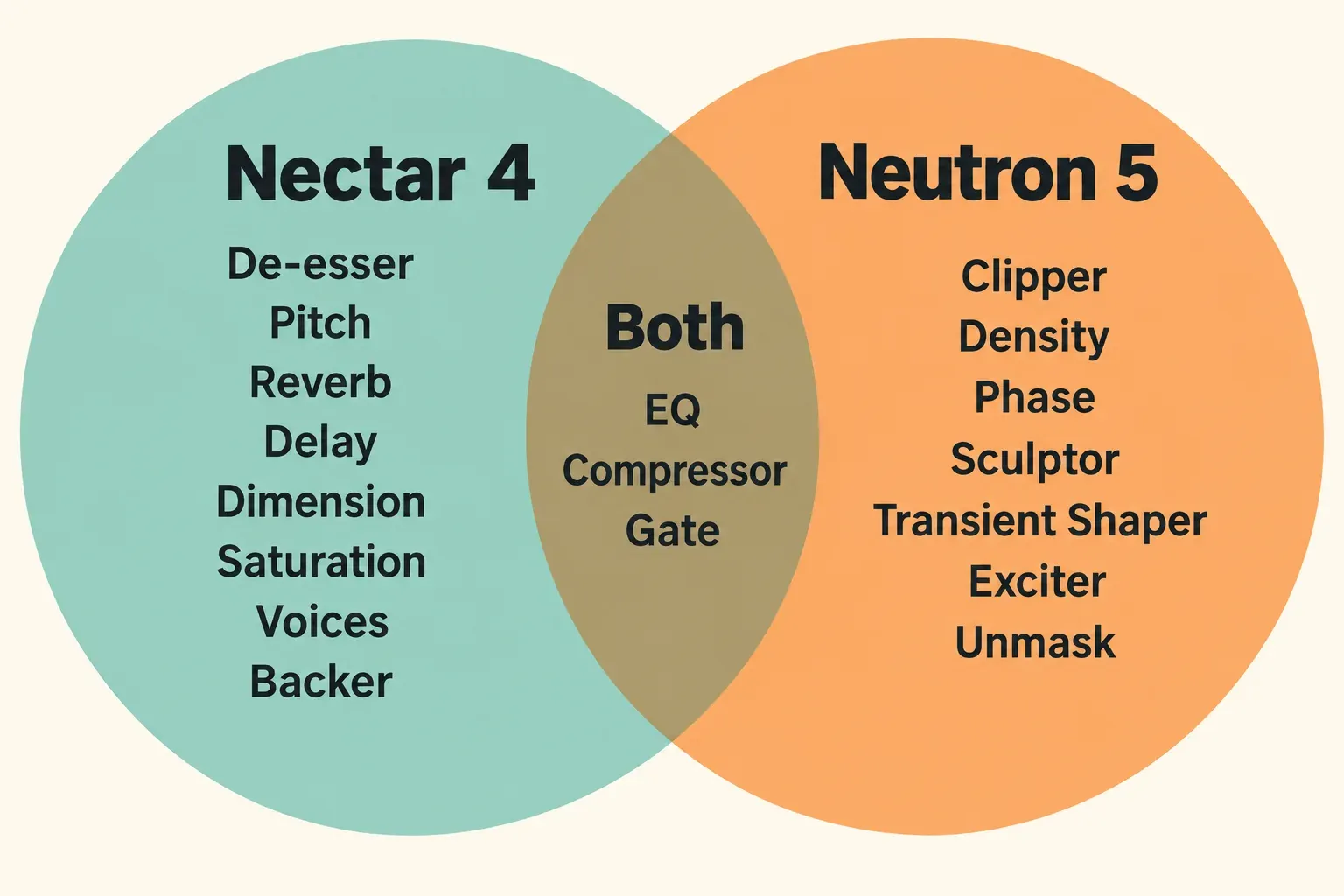
The Neutron-only column is where most of its value sits. Clipper, Density (an upward compressor) and Phase (alignment between related tracks) all arrived in version 5, and our Neutron 5 review covers each of them in detail. Nectar's exclusive column is almost entirely vocal: pitch, sibilance, space and extra voices.
Nectar vs Neutron for vocals
Nectar is the vocal tool, and on a lead vocal it covers ground Neutron can't reach. A typical vocal chain needs a de-esser, pitch correction, a reverb or delay, and sometimes doubles or harmonies. Nectar 4 Standard has all of them in one plug-in, and the Nectar 4 Vocal Assistant documentation lists what it sets for a voice: character EQ and dynamics, the vocal register for Voices and Backer, clarity EQ, de-essing, compression and the reverb mix.
Pitch is a two-layer story. Nectar has its own Pitch module, and Standard and Advanced also bundle Melodyne 5 essential for note-by-note editing. Whether that entry tier is enough for your singer is answered in Melodyne Essential vs Assistant. One limit applies to non-English sessions: iZotope says Backer is trained on English-language singing only.
Neutron can still help a vocal, just not with the core vocal jobs. Its Equalizer Learn feature suggests nodes for sibilance, resonance and rumble, but that's a static EQ suggestion, not a de-esser reacting to each "s". The Exciter adds harmonics, and the sidechain Unmask module can duck the frequencies of a guitar or synth that clash with a vocal. MusicRadar's mixing test shows the risk of leaning on it for vocals: the Neutron 5 Assistant's vocal setting sounded very harsh on one of three songs.
Forum threads disagree on this partly because the official advice is old. iZotope's own "Nectar or Neutron?" guide, written in the Neutron 2 and Nectar 3 era, calls vocals a toss-up and says Neutron's exciter sounds "inherently different" from Nectar's saturator. Both suites have changed since, and Sound On Sound's Neutron 5 review now describes Nectar as the suite that "focuses on vocal production".
Without Nectar, sibilance can also be fixed destructively in an editor, as shown in reducing sibilance in Sound Forge. For the rest of a vocal chain, from repair to space, see the best iZotope plugins for vocals.
Vocal Assistant vs Mix Assistant
Both assistants listen to the track and build a starting chain, but Nectar's is built for one voice while Neutron's works on any instrument. The difference shows in the controls each one leaves you with.
Nectar's Vocal Assistant needs audio playing while it listens, and iZotope advises turning on loop playback for clips under 20 seconds. It finishes on six Intent controls: Shape, Intensity, FX, Width, Voices and Backer. You can steer it with a custom reference, and Nectar 4 also works with Audiolens to tone-match a vocal from a reference track. MusicTech noted that Nectar 4 added an overview page with macro controls, in the style of Neutron and Ozone.
On the other side, Neutron's Mix Assistant builds a chain for a track from instrument profiles or your own references, then hands you four macros: Tone, Dynamics, Saturation and Width. It's quick, too. Mix's real-world review timed it at about six seconds per setting on an M2 Mac mini, with vocals among the sources. Neutron adds a second, session-wide assistant in Visual Mixer, which sets static levels in five groups, Focus, Voice, Bass, Percussion and Musical, with group sliders that move up to 12 dB either way.
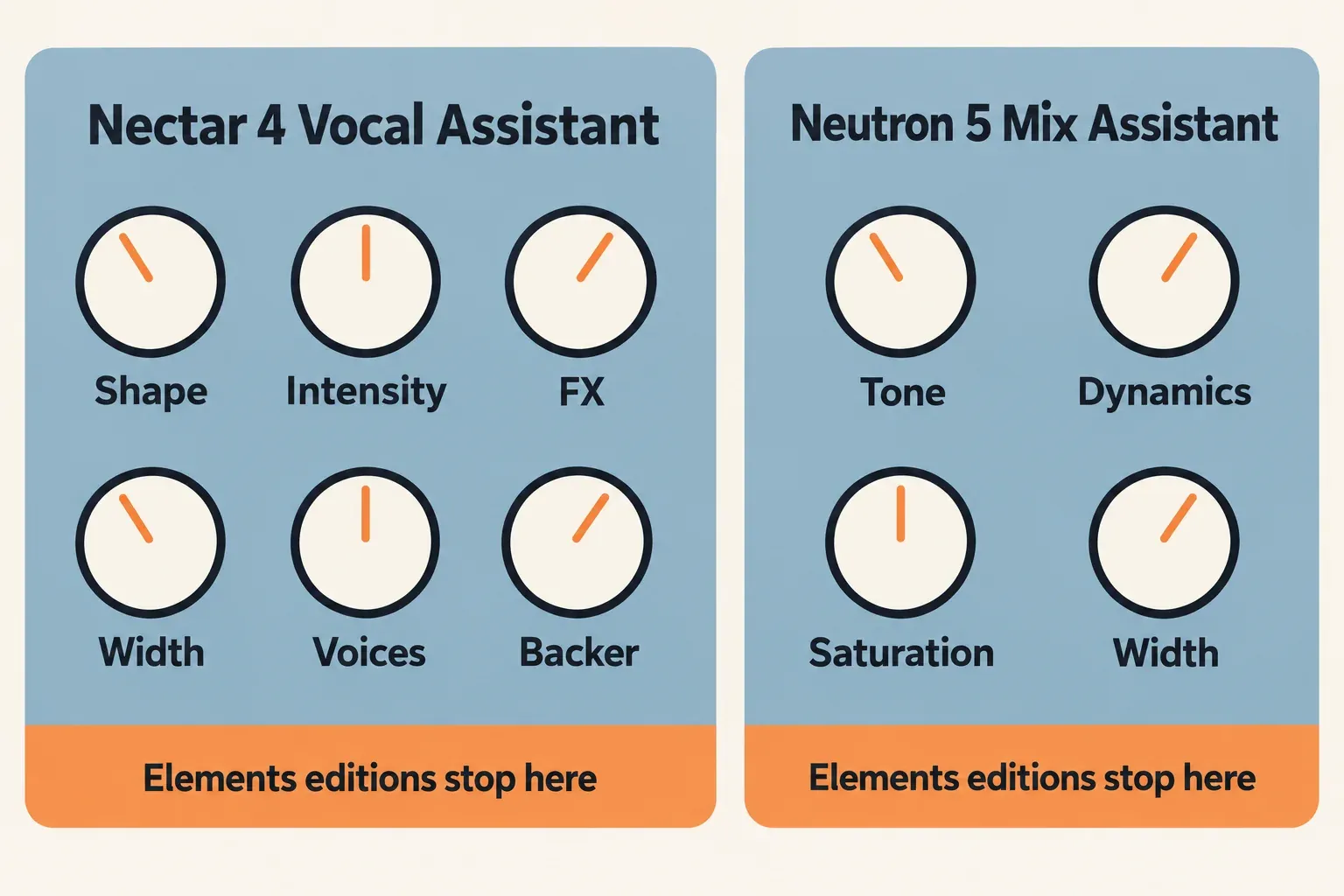
Budget buyers should know where the Elements editions stop. Per the Neutron 5 Elements documentation, Elements is the Mix Assistant and its four Intent controls, with no deeper module access. Nectar Elements works the same way: the Vocal Assistant, 11 harmony styles in Voices and 8 Backer personas, but no editable EQ, compressor, de-esser or reverb.
Vocal Unmask, Relay and Visual Mixer: how they talk to each other
Vocal Unmask is a Nectar feature, and it doesn't need Neutron. The Nectar 4 Unmask documentation says the track masking your vocal needs one of three iZotope plug-ins as its source: Relay, Nectar or Neutron. Relay is a lightweight channel strip that comes with Nectar Standard and Advanced, so a singer working over a stereo beat already has everything required.
- Put Nectar 4 Standard or Advanced on the vocal track.
- On the track that masks it, such as the beat or a music bus, insert Relay, Nectar or Neutron after every other insert.
- Run Unmask in Nectar; it cuts the masking track with an EQ curve so the vocal comes forward.
When Neutron is the source, Nectar writes its cut onto Neutron's output, and an Unmask box appears above Neutron's I/O meters. Neutron's own Unmask module is a different tool. It runs from a sidechain signal and ducks the frequencies of its input that clash with that source, so it works between any two tracks, not only a vocal and its backing.
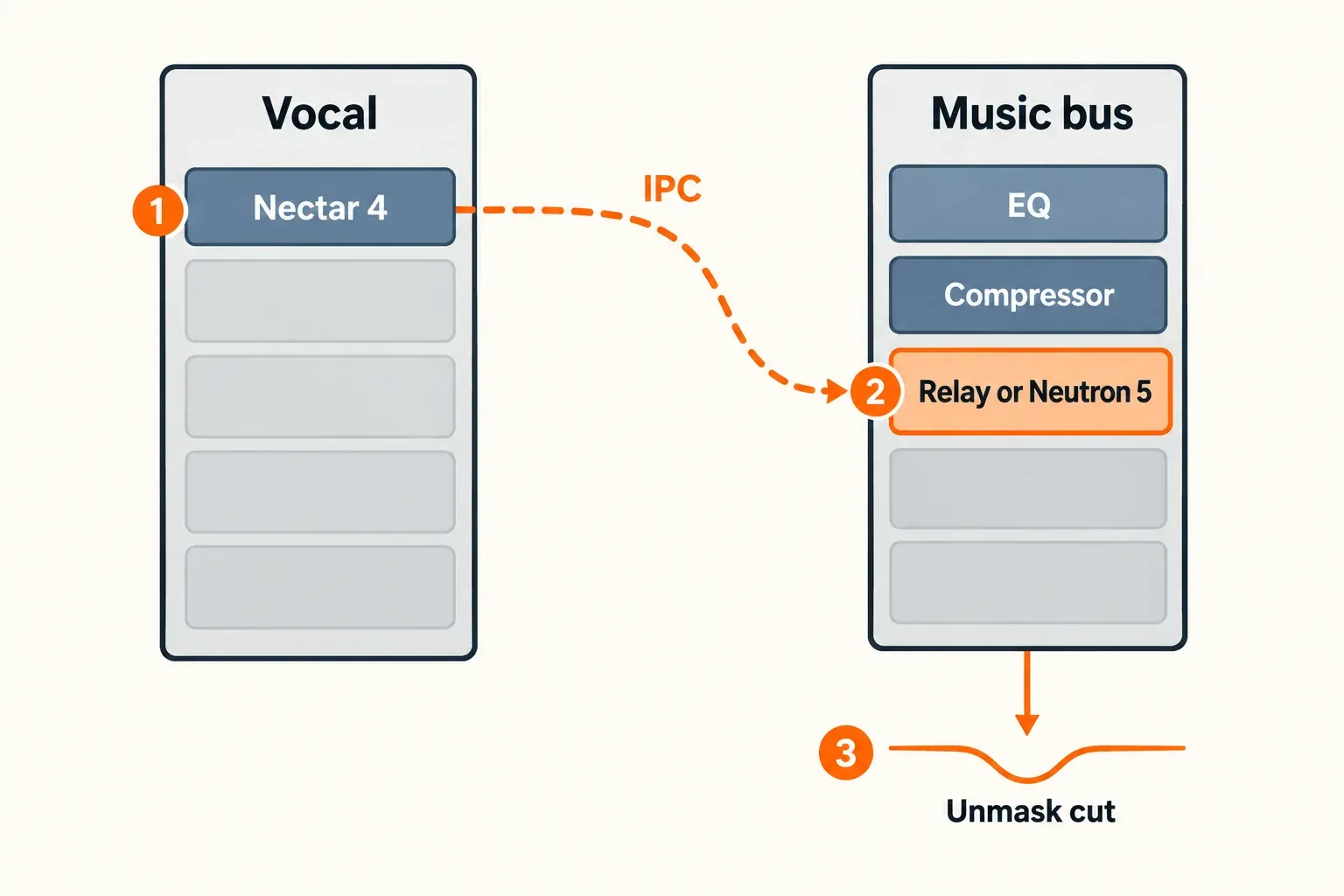
All of this runs on inter-plugin communication, or IPC. Nectar's mothership uses it to address tonal balance and masking against other iZotope plug-ins in the session, and Neutron's Masking Meter, inside its Equalizer, uses it to highlight clashes between tracks. Visual Mixer goes one step further. Per the Visual Mixer Assistant documentation, it sets levels on tracks hosting the Neutron 5 mothership, Neutron components or Relay, and its compatible list leaves out Clipper, Density and Phase.
Two chart details are worth reading carefully before you buy. iZotope's Nectar chart lists control with Neutron's Visual Mixer for the Nectar mothership in Standard and Advanced, while the Neutron manual's Visual Mixer chapter names only Neutron instances. The same chart lists Vocal Unmask in the detailed rows for Standard and Advanced, yet one summary row ticks it for Advanced alone, so confirm it in a trial if Unmask is your reason to buy Standard.
Test results: what published reviews of both show
Nobody has published a same-material shootout, so this composite counts verdicts from separate reviews of each product: nine editorial reviews and four community posts, 13 sources in all. The editorial verdicts are positive for both, and the catches are consistent.
| Source | Product | Verdict on its own terms | Main catch |
|---|---|---|---|
| Sound On Sound, March 2024 | Nectar 4 Advanced | "Great bang for that buck"; the Assistant is "a very easy and effective point of entry" | No cons listed |
| MusicTech, October 2023 | Nectar 4 | 9/10, with a "dramatically improved" Auto-Level | Backer can sound artificial; uninspiring reverbs; CPU hungry with multiple modules running |
| Sound On Sound, January 2025 | Neutron 5 | A worthwhile evolution and good value | No reverb or ambience treatment |
| MusicRadar review, October 2024 | Neutron 5 | 4 out of 5; ease of use is its biggest asset | New modules add little that's truly innovative |
| MusicRadar mixing test, December 2024 | Neutron 5 | Three songs: engineer 2, draw 1, Assistant 0; the processors themselves called excellent | A very harsh vocal setting on one song |
| Mix, February 2025 | Neutron 5 | An excellent value; about six seconds per Assistant setting | Often too much saturation on clean sources |
| Making A Scene, October 2025 | Neutron 5 | Use the Assistant to "beat the blank page"; Relay plus Visual Mixer is useful | Watch CPU when it's loaded everywhere |
| Plugin Noise, 2025 | Neutron 5 | The Assistant is hit-or-miss but jump-starts a mix | Upward compression and phase alignment exist elsewhere |
A ninth editorial source, a June 2026 Nectar 4 review on MixingGPT, counts for its verdict only, that Standard is the tier most buyers need, because its price details don't match iZotope's store.
Counted together, the sources tell the same story. Nine of the 13 sources treat the assistants as fast starting points that still need ears and macro tweaks, and all nine editorial reviews recommend at least one edition. Six of 13 name Neutron's new tools, Clipper, Density, Phase and the new channel modes, as the reason to buy it, while three single out Nectar's Auto-Level, component plug-ins or Voices and Backer. Three of 13 caught Neutron's Assistant overprocessing: an aggressive drum bus, extra saturation on clean sources, and that harsh vocal.
Cautions line up as well. Four of 13 report CPU load with many modules or instances, three editorial reviews and one KVR poster who named Neutron and Nectar among the plug-ins that put a visible drag on their system. Four say engineers with an established chain gain little, including one Gear Page user who found no real benefit over Logic's stock plug-ins on a vocal mix, and a Gearspace user who called Nectar 4 "a generic channel strip plugin" next to a Manley Voice Box. Three question the upgrade pricing for existing owners, among them KVR posters at Neutron 5's launch, who praised Clipper and Density in the same thread.
Because the two numeric scores sit on different scales, 9/10 for Nectar 4 and 4 out of 5 for Neutron 5, I wouldn't average them into one number. Read side by side, the reviews back the split this page recommends: Nectar for the voice, Neutron for the mix, and neither assistant as a finished result.
Latency, CPU and supported hosts
Neutron's output limiter is the one documented latency cost in this pair. Nectar's limiter is a brickwall, zero-latency design, and iZotope lists no other per-module latency for Nectar. Neutron's depends on the mode: at 48 kHz, IRC II adds 3,446 samples, Hard adds 198, IRC LL adds 120 and Zero-L adds none. Neutron also has a Zero Latency mode, but it switches off Sculptor, Unmask and limiter mode selection. Both are output limiters in the mothership, and how a limiter differs from a compressor is explained in compressor vs limiter.
iZotope publishes no CPU figures for either product. Reviewers fill the gap only in words: Sound On Sound calls a single Neutron instance not particularly onerous but warns about running it on every track of a big project, and Making A Scene suggests freezing tracks or loading only the component modules you need. On the vocal side, MusicTech calls Nectar 4 CPU hungry with multiple modules running.
Both run as AU, AAX and VST3, 64-bit only, on Intel and Apple silicon Macs and on Windows 10 and 11. The current pages list macOS Sonoma 14.7 and Sequoia 15.7 for both, with Tahoe 26.6 on the Nectar 4 Advanced product page and 26.2 on the Neutron page. Neutron 5 dropped VST2 at launch. The two host lists also differ: Neutron's names older versions, such as Pro Tools 2025 where Nectar's names Pro Tools 2026, so check your own host on the page of the product you're buying.
Sound Forge Pro is on neither supported-host list. Both ship as VST3 plug-ins, so if you want Nectar on a voice chain inside Sound Forge, confirm it loads in the trial before paying. If a VST3 doesn't appear in Sound Forge at all, start with Sound Forge VST plugins not showing. Authorization and install errors for both suites are covered in iZotope Product Portal fixes.
Editions and prices side by side
The full versions cost $199 for Nectar Standard and $299 for Nectar Advanced or Neutron 5, and both Elements editions are $55. Crossgrades apply if you own any paid iZotope product, and education pricing is half of list.
| Edition | What it is | List price | Crossgrade, update or step-up | EDU |
|---|---|---|---|---|
| Nectar 4 Elements | Vocal Assistant and Intent controls, no editable modules | $55 | $145 to Standard, $245 to Advanced | $27.50 |
| Nectar 4 Standard | Every processing module except Auto-Level and Breath Control, plus Relay and Melodyne 5 essential | $199 | $149 crossgrade, $99 update | $99.50 |
| Nectar 4 Advanced | Standard plus Auto-Level, Breath Control and 13 component plug-ins | $299 | $249 crossgrade, $149 update | $149.50 |
| Neutron 5 Elements | Mix Assistant with Tone, Dynamics, Saturation and Width | $55 | $245 to Neutron 5 | $27.50 |
| Neutron 5 | All ten modules, Visual Mixer and Relay | $299 | $199 crossgrade or update | $149.50 |
Starting on Elements costs a dollar more in the long run: $55 plus $145 comes to $200 for Nectar Standard, and $55 plus $245 comes to $300 for Neutron. What separates Nectar Elements, Standard and Advanced in detail is covered in Nectar 4 Elements vs Standard vs Advanced. Crossgrade and update rules across the catalog are in the iZotope price and upgrade guide.
Sales have cut these prices before. PluginDeals, a third-party price tracker, logged Neutron 5 and Nectar 4 Advanced at $165.75 on Black Friday 2025 and Nectar 4 Standard at $116.80 in November 2025; that's history, not a forecast. Check November pricing before paying $299, and see iZotope Black Friday deals for the current offers.
Do you need Nectar and Neutron?
Most people need one. Both make sense if you produce and mix full songs with vocals in them and want Nectar's vocal tools on the voice plus Neutron's Clipper, Density and Transient Shaper on everything else. Remember that Vocal Unmask already works through Relay, so unmasking alone is no reason to add Neutron.
The cheapest routes to both are a subscription or a crossgrade. The iZotope subscriptions page lists Plus at $15 a month or $150 a year with Neutron 5 and Nectar 4 Standard, and Pro at $25 a month or $250 a year with Neutron 5 and Nectar 4 Advanced, each with a 7-day free trial. To own them outright, my arithmetic from the store labels runs like this:
- Nectar Standard at $199, then the Neutron crossgrade at $199: $398.
- Neutron at $299, then the Nectar Standard crossgrade at $149: $448.
- Both at list: $498.
Buying Nectar first saves $50 over the reverse order, and $398 equals a little over two and a half years of Plus. Crossgrades need a qualifying paid iZotope product, so check eligibility at checkout before you count on that path.
The bundles cost more for these two alone. Music Production Suite 9 at $799 holds Neutron 5 and Nectar 4 Advanced, and so does Mix & Master Bundle Advanced at $599. Nectar Advanced plus Neutron at list is $598, one dollar under that bundle, which also adds Ozone 12 Advanced, Tonal Balance Control 3 and Neoverb. Mix & Master Standard at $429 has no Nectar, and Elements Suite 12 at $149 gives you both assistants without editable modules. Note that the $398 route gets you Nectar Standard, not Advanced. If you also want Ozone or RX, the per-product math is in iZotope bundles compared. Neutron's other usual pairing is weighed in Neutron 5 vs Ozone 12.
Which one to buy: decision table
Find the row that matches the work you do most weeks. Prices are the US store list prices above.
| Your work | Buy | Why |
|---|---|---|
| Podcaster or voice-over artist | Nectar 4 Standard, or Elements for Assistant-only polish | De-esser, compressor, gate and EQ for voice in one plug-in |
| Singer-producer recording over beats | Nectar 4 Standard | Pitch, doubles, space, and Vocal Unmask through Relay on the beat |
| Beat-maker or band mixer | Neutron 5 | Clipper, Density, Transient Shaper and Visual Mixer across the session |
| Mix engineer with a trusted vocal chain | Neutron 5, skip Nectar | Nectar's extras duplicate tools you already own |
| Producer-mixer finishing full songs | Plus subscription, or Nectar Standard plus the Neutron crossgrade | Both sets of exclusives for $150 a year or $398 once |
| Owner of one of the two | The crossgrade to the other | $199 for Neutron 5, $149 for Nectar Standard |
| Sound Forge editor working on voice | Nectar 4 Standard, after the trial | Sound Forge Pro isn't on either host list |
For a voice-over workflow built around the editor itself, see Sound Forge Pro for voice-over recording.
My verdict
Buy Nectar 4 Standard for voice work and Neutron 5 for mixing whole songs; they share three processing modules and little else. I wouldn't buy either one for its assistant alone, since the reviews agree it's a starting point rather than a finished sound. If you need both, I'd take the Plus subscription if you'd also use the Ozone 12 Standard and RX 12 Elements it includes, or Nectar Standard first and the $199 Neutron crossgrade when you'd rather own them. With November close, check the current offers before paying full price.