
Choose Waves Clarity Vx when the job is one voice over steady noise, such as a fan, an air conditioner or distant traffic, and you want a single real-time knob at a low price. Choose iZotope RX 12 Standard or Advanced when noise is only one of several faults in the file: RX Dialogue Isolate finished ahead of Clarity Vx Pro in Production Expert's 2024 and 2025 blind listening votes, and RX adds spectral repair tools that the Clarity line does not have.
I decide this one by the shape of the problem first and the price second. On October 21, 2026, Clarity Vx was $49.99 on the Waves store during its Studio Legends Sale, against a $199 list price, while RX 12 Standard was $399 in the iZotope US store with no discount. For a podcast or YouTube voice recorded next to a humming AC unit, I would buy Clarity Vx and stop there. Once the same file also has crackle, camera noise or a door slam, I would rather own RX, because those faults need selection-based repair, not a voice-versus-noise balance. And if your budget already reaches Clarity Vx Pro, I would try RX 12 Standard's Dialogue Isolate first and move to Advanced only for its Best/Offline mode and four bands.
Quick verdict by job
Match the tool to the fault you hear most often. Prices are US store prices on October 21, 2026.
| Job | Start with | Why |
|---|---|---|
| One voice over a steady fan, hum or traffic | Clarity Vx | One main knob, real-time insert, $49.99 on sale ($199 list) |
| A voice over changing background noise you want to balance precisely | RX 12 Standard Dialogue Isolate; Advanced for Best/Offline | Separate Voice, Reverb and Noise faders; finished ahead of Clarity Vx Pro in the 2024 and 2025 blind votes |
| Crackle or narrow camera noise | RX 12 Standard | Spectral editing and Spectral Repair won those clips; no Clarity plugin has an equivalent |
| Door slams and other bangs | Neither separator; repair them by selection in RX | Noise reducers are not built to target transients |
| Room reverb on a voice | Audition Clarity Vx DeReverb and RX De-reverb or Dialogue Isolate's Reverb fader | Neither family reached the top two in Production Expert's 2024 reverb vote |
| Lowest outlay | Clarity Vx on sale ($49.99) or RX 12 Elements ($99) | Elements has Voice De-noise and De-reverb plugins but no Dialogue Isolate |
| Surround or other multichannel files | RX 12 Advanced | Clarity plugins come as mono and stereo components only |
The iZotope RX hub collects the edition, price and repair guides that sit around this comparison.
Which Clarity plugin to compare with which RX edition
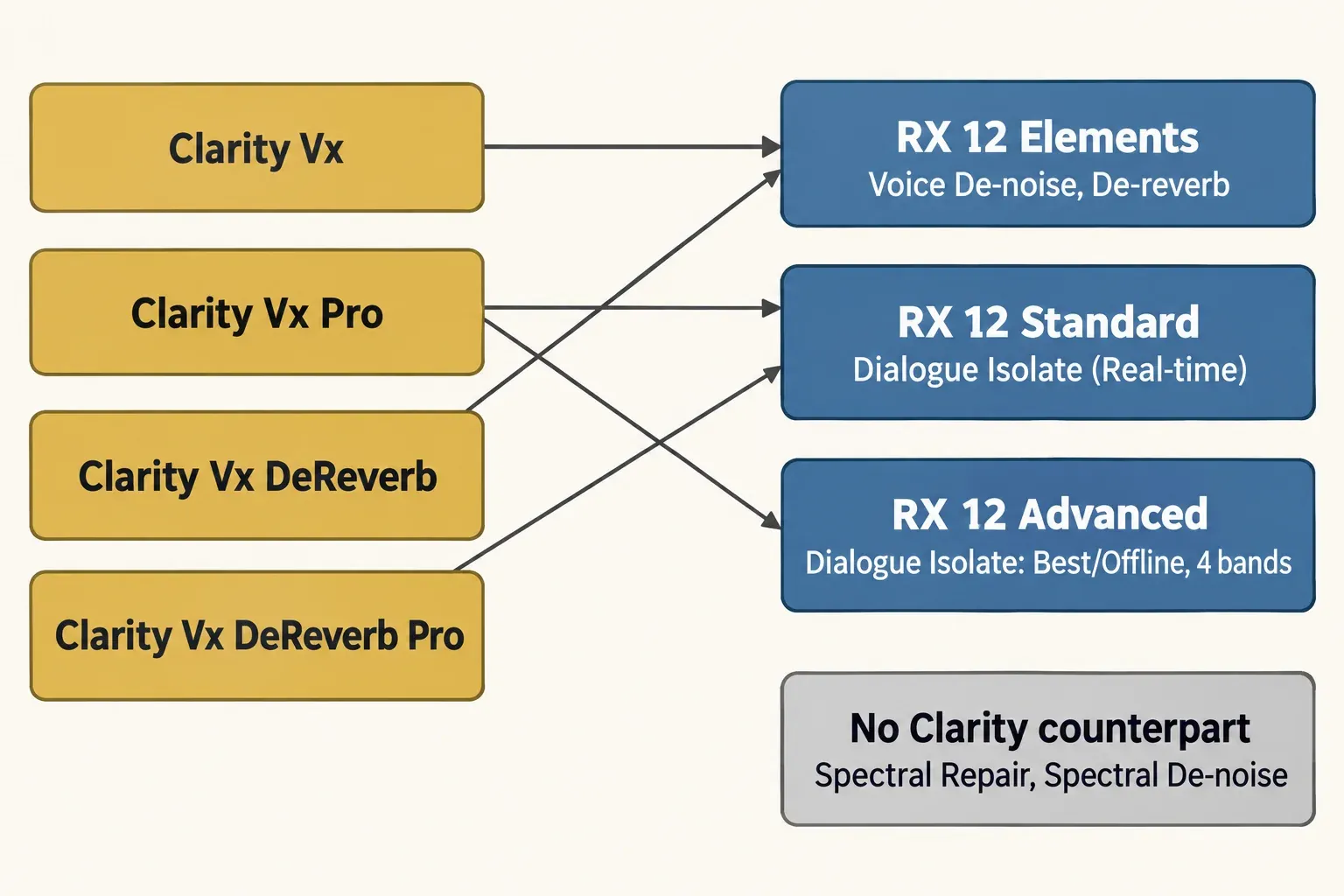
"Clarity Vx vs RX" is really four Waves plugins against three RX 12 editions, and most confusion comes from comparing the wrong pair. The fair pairings look like this:
- Clarity Vx and RX 12 Elements are the entry points. iZotope's RX 12 Elements page lists plugin versions of De-click, De-clip, De-hum, De-reverb and Voice De-noise, and in Elements Voice De-noise runs only as a plugin. Dialogue Isolate is not part of Elements.
- Clarity Vx Pro and Dialogue Isolate in RX 12 Standard or Advanced are the flagship separators. Both use neural networks to pull a voice away from noise, and both give you more than one control over the result. Standard runs Dialogue Isolate in its real-time mode; Advanced adds a high-quality offline mode and four-band processing.
- Clarity Vx DeReverb and DeReverb Pro line up against RX De-reverb, which is in all three editions, and against the Reverb fader inside Dialogue Isolate in Standard and Advanced.
- Spectral Repair and Spectral De-noise, both in RX 12 Standard and Advanced, have no Clarity counterpart at all.
Published comparisons follow the same split. The Podcast Host set standard Clarity Vx against RX Voice De-noise, the entry-level pairing, while Pro Video Coalition's RX 11 shootout left Voice De-noise out because it did not compete with the dialogue isolators, and put Clarity Vx plus Clarity Vx DeReverb against RX's dialogue tools. If you are unsure which RX edition you need in the first place, the RX 12 Elements vs Standard vs Advanced comparison goes through what each edition leaves out.
Price, subscriptions and licenses
Waves prices move with its frequent sales, so read the sale column below as a dated snapshot and the list price as the ceiling. On October 21, 2026, the Waves store was running its Studio Legends Sale.
| Waves plugin | Sale price, Oct 21, 2026 | List price | Waves Essential | Waves Ultimate |
|---|---|---|---|---|
| Clarity Vx | $49.99 | $199 | Included | Included |
| Clarity Vx Pro | $249 | $699 | Not included | Included |
| Clarity Vx DeReverb | $49.99 | $129 | Included | Included |
| Clarity Vx DeReverb Pro | $149 | $249 | Not included | Included |
Waves' subscription plans price Essential at $14.99 a month or $149.99 a year and Ultimate at $24.99 a month or $249.99 a year. A year of Ultimate costs 99 cents more than Clarity Vx Pro on sale and also brings DeReverb Pro, so if you need the Pro tools for one project, a few months of Ultimate is the cheaper route. A perpetual purchase includes one year of the Waves Update Plan, and the plugin keeps working after that year ends. Waves' comparison of perpetual licenses and subscriptions adds two details: Ultimate covers more than 240 plugins and Essential more than 110, and a perpetual license runs on one system, with a second only while the Update Plan is active, whereas a subscription runs on two systems.
| RX 12 edition | Price, iZotope US store, Oct 21, 2026 | Subscription that includes it | Dialogue Isolate |
|---|---|---|---|
| RX 12 Elements | $99 | iZotope Plus, $15 a month or $150 a year | Not included |
| RX 12 Standard | $399 | iZotope Pro, $25 a month or $250 a year | Real-time mode |
| RX 12 Advanced | $1,399 | Not listed in either plan | Adds Best/Offline and four bands |
Upgrade paths shorten the RX gap. Elements owners can move to RX 12 Standard for $299, owners of any paid iZotope product can crossgrade to Standard for $349, and RX 11 Standard owners update for $129. Going from RX 12 Standard to Advanced costs $999, and RX 11 Advanced owners update for $269. iZotope's subscription plans list RX 12 Elements and Standard, not Advanced, so Best/Offline and the four bands mean buying Advanced outright. Both companies offer a 7-day trial on their subscriptions, and iZotope subscriptions are serviced through Native Instruments.
On these numbers, Clarity Vx on sale costs about half of RX 12 Elements, and that is a fair price for what it does. Clarity Vx Pro is a different question: at $249 on sale it sits $150 below RX 12 Standard, which also brings Spectral Repair and Spectral De-noise. The RX price, trial and license guide explains what the two RX trials allow and the license rules for computers and transfers, and the iZotope upgrade price guide lists every update and crossgrade route into RX 12.
How Clarity Vx, Clarity Vx Pro and Dialogue Isolate work
Clarity Vx: one knob, three networks
Clarity Vx is built around one main knob that sets the balance between voice and noise, and Waves' Clarity Vx page says it uses the same neural engine as the Pro version. You choose between two Broad networks for different noise characters and an ECO network for low-CPU dialogue cleaning. Waves recommends Broad 2 for severe noise and for separating a main voice from voices in the background, and Broad 1 when a recording has several voices you want to keep. A Double mode analyzes each stereo channel separately.
The Clarity Vx user guide adds the practical details. Broad ECO is not intended for noise removal on sung vocals, and Single mode uses considerably less CPU than Double. The plugin works in real time as a channel insert or as an offline processor, and it resets its neural network each time playback stops.
Clarity Vx Pro: bands, reflections and a gate
Waves' Clarity Vx Pro page lists what the extra money buys: six processing bands, each with its own process amount, solo, delta and bypass; four neural networks, by Waves' count; a Reflections control that brings back natural reflections after cleaning; a neural ambience gate that lowers the level between lines; and a built-in limiter to prevent clipping. It can also keep the background ambience and remove the voice, which gives you material for room-tone fills. Waves describes the plugin as fully automatable, including the advanced controls.
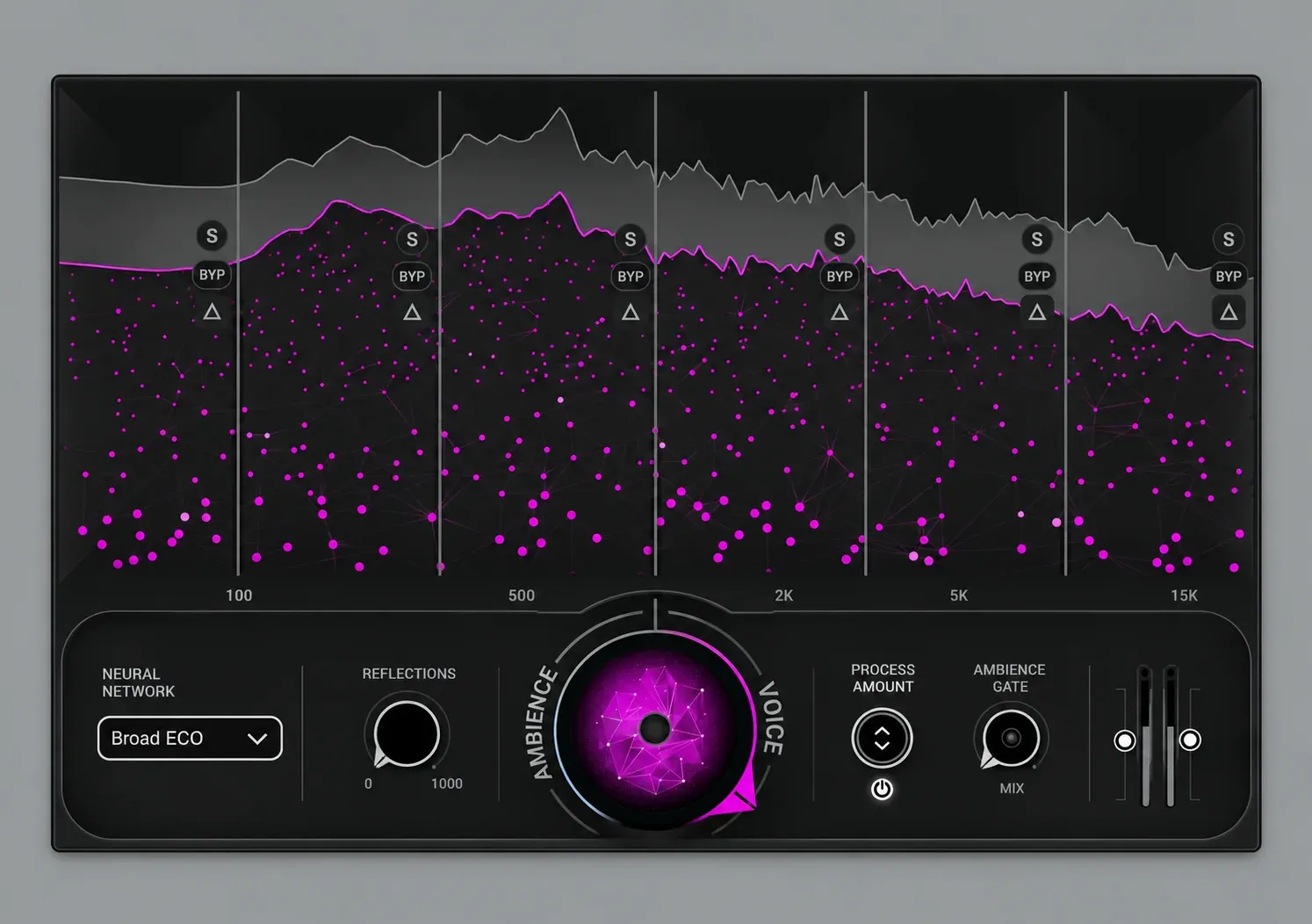
I would pay for Pro only if per-band control is the point. The bands let you treat the low end differently from the presence range, which the standard version's single knob cannot do, and one of The Podcast Host's reservations about the standard Clarity Vx was that it offers little manual control.
Dialogue Isolate: three faders and two quality modes
The RX 12 Dialogue Isolate documentation describes a module that separates dialogue from both constant and non-stationary background noise, includes reverb removal, and gives you separate gains for Voice, Reverb and Noise. Its Good/Real-time mode is optimized for low latency and plugin use; Best/Offline gives fewer artifacts and better isolation in exchange for longer processing and higher latency. The Advanced version adds that offline mode and a four-band mode with Low, Low Mid, High Mid and High bands, and its documentation lists a Stem Split button that divides the selected audio into three stems. iZotope warns that raising Sensitivity can introduce artifacts and reduce clarity. iZotope's RX 12 Standard page lists improved Dialogue Isolate neural nets among the version's changes.
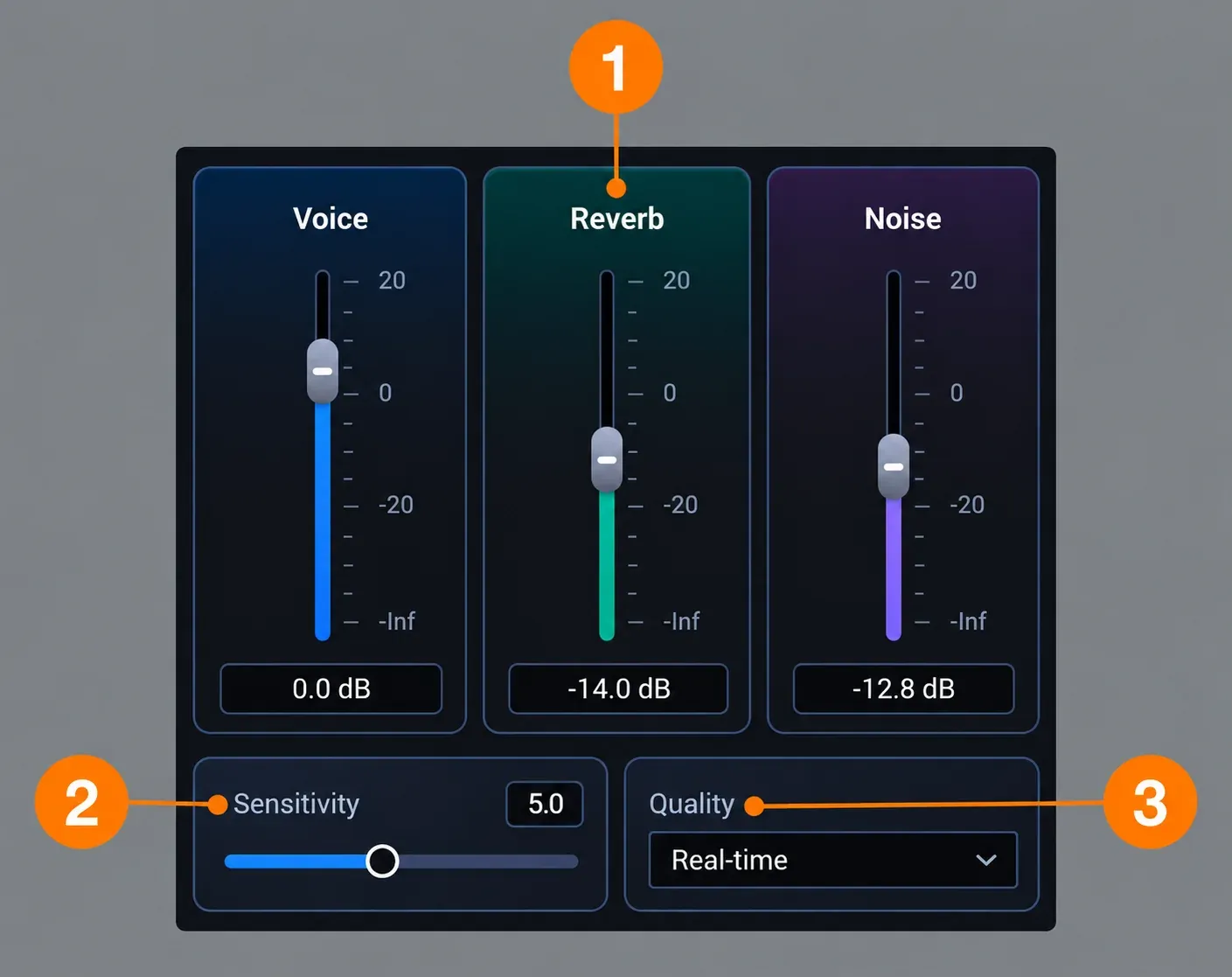
The practical difference from Clarity: Dialogue Isolate puts noise and room reverb on two separate faders in one module, while Waves handles reverb with a separate DeReverb plugin. The Dialogue Isolate settings guide explains what each control does and which settings keep the voice natural.
Test results: what published comparisons show
No two sources measured RX and Clarity on the same scale. The published evidence is blind listening votes, placings and reviewer verdicts on different material, so this composite counts outcomes across nine sources from 2022 to 2026 instead of averaging scores.
| Source and date | Versions compared | Method | Result |
|---|---|---|---|
| Production Expert premium shootout, Aug 2022 | RX 9 Advanced, Clarity Vx Pro, Acon Acoustica 7, Sonnox Restore | Blind community vote, samples labeled A to D | Three-way tie at 10 points; Clarity won buzz and hiss, RX won fan noise and crackle |
| Production Expert noise listening test, Jan 2024 | RX Dialogue Isolate, Clarity Vx Pro and four others | Blind vote, four noise clips | RX 369 votes, third of six; Clarity 191, sixth |
| Production Expert reverb listening test, Jan 2024 | RX De-reverb, Clarity Vx DeReverb Pro and four others | Blind vote, extreme reduction settings | Neither in the top two in any of four rooms |
| Production Expert dialogue shootout, Jun 2025 | RX Dialogue Isolate from RX Advanced, Clarity Vx Pro and six others | Blind vote, samples labeled A to H, four examples | RX placed 2nd, 3rd, 3rd and 4th; Clarity 6th, 6th, 6th and 7th |
| Pro Video Coalition RX 11 shootout, May 2024 | RX 11 dialogue tools without multiband, Clarity Vx with Clarity Vx DeReverb | Reviewer listening, noise reduction pushed hard | RX "a bit more reliable" with lower overall artifacts; Clarity won traffic plus reverb |
| The Podcast Host, Jan 2024 | Clarity Vx on Broad 2, RX Voice De-noise | Reviewer listening, podcast clips with fan noise and door slams | Clarity preferred on the fan; neither removed the door slams |
| Music Radio Creative, Feb 2025 | Waves Clarity, iZotope RX | Reviewer listening, one noisy sample at maximum settings | Little difference in quality, called a tie; Clarity simpler |
| Production Expert RX 11 review, May 2024 | RX 11 Dialogue Isolate, AAX plugin | Plugin latency reading | 2048 samples in real time, the figure Waves lists for Clarity at 44.1 and 48 kHz |
| Pro Video Coalition RX 12 shootout, May 2026 | RX 12 vs RX 11 Dialogue Isolate, same settings, no Clarity | Reviewer listening, three dialogue clips | Better on steady noise and heavy traffic; little or no change on a phone recording with room reverb |
Read across the nine sources, the composite comes out like this:
- Blind votes: RX ahead in 2 of 3. In the three Production Expert blind events that included both tools, RX finished ahead of Clarity Vx Pro in 2024, with 369 votes to 191, and in 2025, with placings of 2, 3, 3 and 4 against 6, 6, 6 and 7. In 2022 the two were level: Production Expert scored a three-way tie at 10 points and named no clear winner.
- Head-to-head verdicts: RX 3 of 6, Clarity 1, level 2. RX led in both later Production Expert votes and at Pro Video Coalition, which found RX 11 a bit more reliable with lower overall artifacts. Clarity's one outright verdict came against the lighter Voice De-noise at The Podcast Host. Production Expert 2022 and Music Radio Creative, which heard little difference in quality, sit level.
- Where Clarity wins: 3 of 5 multi-clip tests, all continuous noise. Clarity took transformer buzz and hiss in 2022, heavy traffic plus reverb in Pro Video Coalition's third test, and the fan clip at The Podcast Host. It won no individual clip in the 2024 or 2025 Production Expert votes.
- Where RX wins: 3 of its 4 clip wins came from targeted tools. Spectral De-noise won the 2022 fan-noise test with Clarity Vx Pro runner-up, spectral editing with several modules won the 2022 crackle test, and Spectral Repair was the only tool in Pro Video Coalition's shootout that removed the camera noise completely. The fourth was Dialogue Isolate itself, which kept the original tone of the voice best in that shootout's first test.
- Ease of use: Clarity in 3 of 3. Every source that commented on workflow called Clarity the simpler or set-and-forget option and RX the larger toolset, and all three sources that gave buying advice sent budget or one-plugin users to Clarity and heavier repair work to RX.
- Door slams and reverb: no winner. Neither tool removed The Podcast Host's door slams, and neither family reached the top two in any of the four rooms in Production Expert's reverb vote.
Two conditions shape how far to lean on this. First, some tests pushed settings on purpose: Production Expert's reverb vote used extreme reduction, and Pro Video Coalition pushed noise reduction hard to expose differences, so artifacts show up more than they would at moderate settings. Second, every head-to-head with Clarity predates RX 12. Pro Video Coalition's RX 12 shootout bridges part of that gap without Clarity in the room: with the same settings as RX 11, RX 12's Dialogue Isolate gave a noticeably clearer voice with less artifacting on steady background noise, and significantly less voice artifacting on heavy traffic, though with an occasional booming reverb artifact. On a phone recording with room reverb it heard little or no gain, and the reviewer concluded that the improved neural nets iZotope claims do seem to be there. The RX 12 vs RX 11 comparison covers what else changed between the versions.
Clarity's low placings are not the whole story. In its 2025 results, Production Expert noted that several of its team use Clarity Vx Pro successfully in their restoration work, that no plugin won all four examples, and that Supertone Clear led the vehicle example with RX a solid second. In the 2025 setup notes, Production Expert explains that Dialogue Isolate was auditioned in Good/Real-time and rendered in Best/Offline, the mode that only RX 12 Advanced offers today. If the tools that topped these votes, such as Hush Pro, Accentize dxRevive Pro and Supertone Clear, interest you more than either brand, the guide to iZotope RX alternatives covers them alongside the published dialogue listening tests.
My verdict on the evidence: Clarity Vx earns its place as the fast, cheap answer to continuous noise under one voice, and it has won real clips in blind and editorial comparisons. RX is the stronger buy when files carry more than one problem, and in the larger blind votes its Dialogue Isolate simply finished higher than Clarity Vx Pro. At list prices I would not pick Clarity Vx Pro ($699) over RX 12 Standard ($399). Even at the October 21 sale price of $249 I would still choose Standard, because Spectral Repair and Spectral De-noise cover the faults that no separator handles.
Room reverb: separate plugins at Waves, built in at RX
Waves sells reverb removal as its own products. Clarity Vx DeReverb ($49.99 on sale on October 21, 2026, $129 list) has dedicated neural networks for speech and for sung vocals, and Clarity Vx DeReverb Pro ($149 on sale, $249 list) adds six precision-processing bands and includes the standard DeReverb. On the RX side, De-reverb is in all three RX 12 editions, and Dialogue Isolate in Standard and Advanced has its own Reverb fader, so one module handles noise and room sound together.
The evidence on reverb is thin and mixed. In Production Expert's 2024 reverb vote, which included Clarity Vx DeReverb Pro and RX De-reverb among six tools at extreme settings, Hush Pro won three of four rooms and dxRevive Pro the fourth; neither Waves nor iZotope reached the top two. At Pro Video Coalition, Clarity Vx paired with Clarity Vx DeReverb won the heavy traffic plus reverb test, and the RX 12 shootout heard little or no improvement over RX 11 on a phone recording with room reverb.
So I would not buy for reverb from a spec sheet. Waves Essential includes Clarity Vx DeReverb, iZotope Plus includes RX 12 Elements with De-reverb, and both subscriptions start with a 7-day trial: put your own worst room recording through both before paying. When echo rather than noise is the main problem, the guide to removing echo from audio without wrecking speech covers the wider set of options.
What neither noise remover fixes on its own
Both separators are built to keep a voice and lower the background around it. Three kinds of fault fall outside that job.
- Door slams and other bangs. The Podcast Host pushed Clarity Vx to 67.8 on Broad 2 and the door slams stayed, with major artifacts added; RX Voice De-noise did not touch them either, and the reviewer points out that noise reducers are not designed to target transients. The fix is selection-based: RX 12's Spectral Repair documentation lists door slams among the sounds it can remove or attenuate from a selection, and its Attenuate mode can bring them down until they blend into the background noise. Spectral Repair is in Standard and Advanced.
- Crackle and narrow mechanical noise. RX won Production Expert's 2022 crackle test with spectral editing and several modules, and Spectral Repair was the only tool to fully remove Pro Video Coalition's camera noise.
- Clicks and clipping. Waves sells the Clarity line for noise and reverb removal. For clicks and clipped peaks, even the $99 RX 12 Elements includes De-click, De-clip and De-hum plugins.
Steady hiss and buzz are where the two meet. Clarity Vx Pro won both the transformer-buzz and hiss clips in Production Expert's 2022 vote, while iZotope's Dialogue Isolate notes suggest also trying Spectral De-noise for stationary noise such as hiss and buzz. For the full RX approach by noise type, the guide on how to remove background noise in iZotope RX 12 sets out which module to use and in what order.
Latency, formats and system specs
| Spec | Clarity Vx plugins | iZotope RX 12 |
|---|---|---|
| Real-time latency | 2048 samples at 44.1 and 48 kHz; 4096 at 88.2 and 96 kHz | Dialogue Isolate AAX: 2048 samples (RX 11, per Production Expert); Voice De-noise: zero latency |
| Channel formats | Mono and stereo only | Advanced lists multichannel processing among its editor features |
| Plugin formats | VST3, AU, AAX | AU, AAX, AAX AudioSuite, VST3; AU and VST3 ARA for some tools |
| Architecture | 64-bit only in V17 | 64-bit only |
| Current version | Waves V17 | RX 12 |
The latency figures for all four Clarity plugins come from the tech specs on Waves' Clarity Vx Pro page, and Waves' supported hosts page confirms the formats and 64-bit-only V17 builds. Clarity supports sample rates up to 96 kHz. At 48 kHz, 2048 samples is about 43 ms: too much delay for monitoring a voice live, and no issue on playback in a host with delay compensation. iZotope's RX 12 product pages confirm macOS Sonoma 14.7, Sequoia 15.8 and Tahoe 26.x, plus Windows 10 (22H2) and Windows 11 (24H2).
On CPU, The Podcast Host found Clarity Vx heavy and Voice De-noise lighter. If Clarity strains your machine, Waves' ECO network and Single mode are the two levers. In RX, Voice De-noise is the light, zero-latency option, while Spectral De-noise uses far more resources and has higher latency, according to iZotope's Voice De-noise documentation. Music Radio Creative found RX took 1 to 5 seconds to play back after applying noise reduction, but did not judge the speed difference large.
Who should buy which
- Podcasters and YouTubers with one mic in a noisy room: Clarity Vx. While the sale lasts it is the cheapest route here, and continuous noise is exactly where it wins clips. If you edit episodes in Sound Forge Pro, the Sound Forge Pro podcast editing workflow covers the rest of the chain.
- Video editors who want one plugin in the NLE: Pro Video Coalition concluded that the much lower price makes Clarity Vx the easier choice for that editor. If you are also weighing CrumplePop, CrumplePop vs iZotope RX sets one-knob cleanup against the full RX repair editor.
- Dialogue editors and restoration work: RX 12 Standard at minimum, for Dialogue Isolate plus Spectral Repair and Spectral De-noise. Move to Advanced if you render finals: Best/Offline is the mode Production Expert rendered with in 2025, and Pro Video Coalition's reviewer said he would plan to use only the offline high-quality version.
- Music producers cleaning sung vocals: be careful with both. Clarity Vx's Broad ECO network is not meant for sung vocals, and Voice De-noise's Dialogue mode is not either. Its Music mode does not attenuate sustained notes and is the more transparent choice on singing. My pick for steady noise under a vocal is Voice De-noise in Music mode, which even RX 12 Elements includes; for reverb on a vocal, Clarity Vx DeReverb has a dedicated sung-vocal network.
- RX 11 Standard owners: pay the $129 update before buying Clarity. RX 12's Dialogue Isolate improved on RX 11 in two of three clips in Pro Video Coalition's comparison.
- Subscribers: Waves Essential already includes Clarity Vx and Clarity Vx DeReverb, and the Pro versions need Ultimate. iZotope Pro at $25 a month gives you RX 12 Standard with Dialogue Isolate.
- If neither fits: the roundup of audio noise reduction software by job covers other options, and if Sound Forge Pro is your editor, start with removing background noise in Sound Forge Pro.
FAQ
Does Clarity Vx Pro process audio in the cloud?
No. Waves' Clarity Vx Pro update notes state that audio is processed locally and not sent to a cloud for processing.
Did Clarity Vx Pro win an Emmy?
Yes. The Clarity Vx Pro product page says it won a 75th Engineering, Science & Technology Emmy. An award does not tell you how it handles your file, though; the blind votes above are the better guide.