
iZotope Trash is worth $99 if you want multiband distortion and convolution on one screen for drums, bass and electronic production. Trash 2 owners should treat it as a different plug-in rather than an upgrade: it drops the Dynamics and Delay modules, the drawn waveshaper and the fourth band. It costs $99 in iZotope's US store on October 29, 2026, or $49 as an update from any earlier Trash, with no sale running.
I would buy Trash for speed. Two XY pads, a dice button that randomizes them and a Swap switch take a drum loop or a bass from clean to wrecked faster than a page of menus, and that workflow is what reviewers and buyers praise most. I'd skip it if you need LFO movement or more than three bands, because Trash has neither and FabFilter Saturn 2 has both for $149 at Plugin Boutique. The full version has no trial, so free Trash Lite is the way to hear the distortion engine before you pay.
- Buy it for drums, percussion, bass and other sounds you want to bend out of shape by ear.
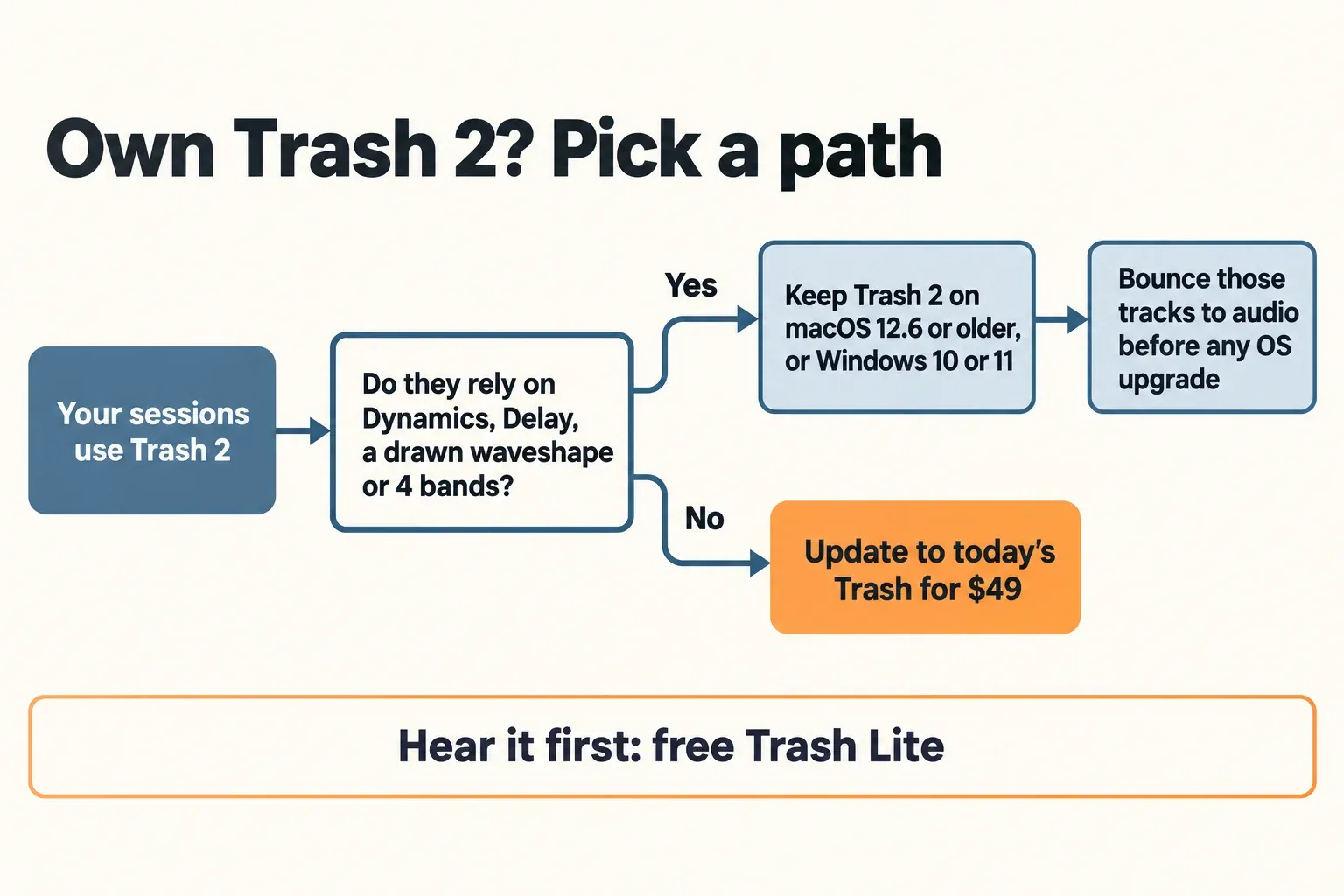
- Update for $49 if you own Trash 2 and your sessions don't depend on its Dynamics, Delay, drawn waveshapes or fourth band.
- Keep Trash 2 running on its current computer if they do, and bounce those tracks to audio before any OS upgrade.
- Look elsewhere if modulation depth matters more than speed; the alternatives section below prices four rivals.
iZotope Trash review: test results
Only two editorial reviews publish a score, and both are lukewarm. MusicTech gave the 1.0.0 launch build 5 out of 10 in March 2024, and MusicRadar gave it 3 out of 5 in August 2024, after version 1.2.0 had added oversampling. Sound On Sound and Mix publish verdicts without scores, and both are warmer. Buyers rate Trash far higher than critics do.
| Source | Date | Build reviewed | Verdict | Main criticism |
|---|---|---|---|---|
| MusicTech (Alex Holmes) | March 25, 2024 | 1.0.0 launch build | 5/10 | Missing the Trash 2 features it was known for, very basic modulation, a limited filter, no oversampling or resizable interface at launch |
| MusicRadar (Si Truss) | August 1, 2024 | After 1.2.0 | 3/5 | Removes Trash 2 features while adding few new ideas, limited modulation, a Scream filter that can sound "fairly unpleasant" |
| Sound On Sound (John Walden) | May 23, 2024 | Desktop release current in May 2024 | No score: "a very capable yet easy-to-use creative distortion plug-in with a stylish GUI and plenty of sound design potential" | Only one custom impulse response per instance; no band-level presets |
| Mix (Mike Levine) | May 30, 2024 | Desktop release current in May 2024 | No score: "Trash will be a boon to anyone who uses distortion creatively" | Non-descriptive distortion type names; the Dynamics, EQ and Delay modules are gone |
MusicTech's score belongs to the launch build. Version 1.1.0 added VST3 resizing and 1.2.0 added oversampling and AU/AAX resizing, so two of its complaints no longer apply, and MusicRadar's 3 out of 5 is the more current editorial number. The two scores use different scales and different builds, so they stand side by side rather than as an average.
Buyer results sit in their own column because no buyer names a version. The Plugin Boutique listing shows 4.6 from 167 ratings, and its 13 written buyer reviews, dated May 12 to October 17, 2026, give a median of 5 stars with a range of 3 to 5: nine 5-star, three 4-star and one 3-star. The iPad app holds 4.2 from 14 ratings on the US App Store.
Across the four editorial reviews, the points of agreement are easy to count:
- 4 of 4 praise the sound and the fast single-screen workflow; MusicTech, Sound On Sound and Mix also single out the size of the distortion and impulse-response library.
- 4 of 4 point out that Trash 2's Dynamics and Delay modules and its extra EQ and filter stages are gone; three of them also miss the drawable waveshaper.
- 2 of 4, MusicTech and MusicRadar, call the modulation limited and say rival plug-ins offer more depth.
- 2 of 4, Sound On Sound and Mix, find it easier to approach than Trash 2's multi-screen design.
- 2 of 4 criticize the filter, while Mix made its Heat control a go-to.
My read of the split: reviewers who knew Trash 2 scored what was removed, while buyers scored what's on screen. Which group you belong to decides the purchase more than any single number here.
What Trash does: modules and controls
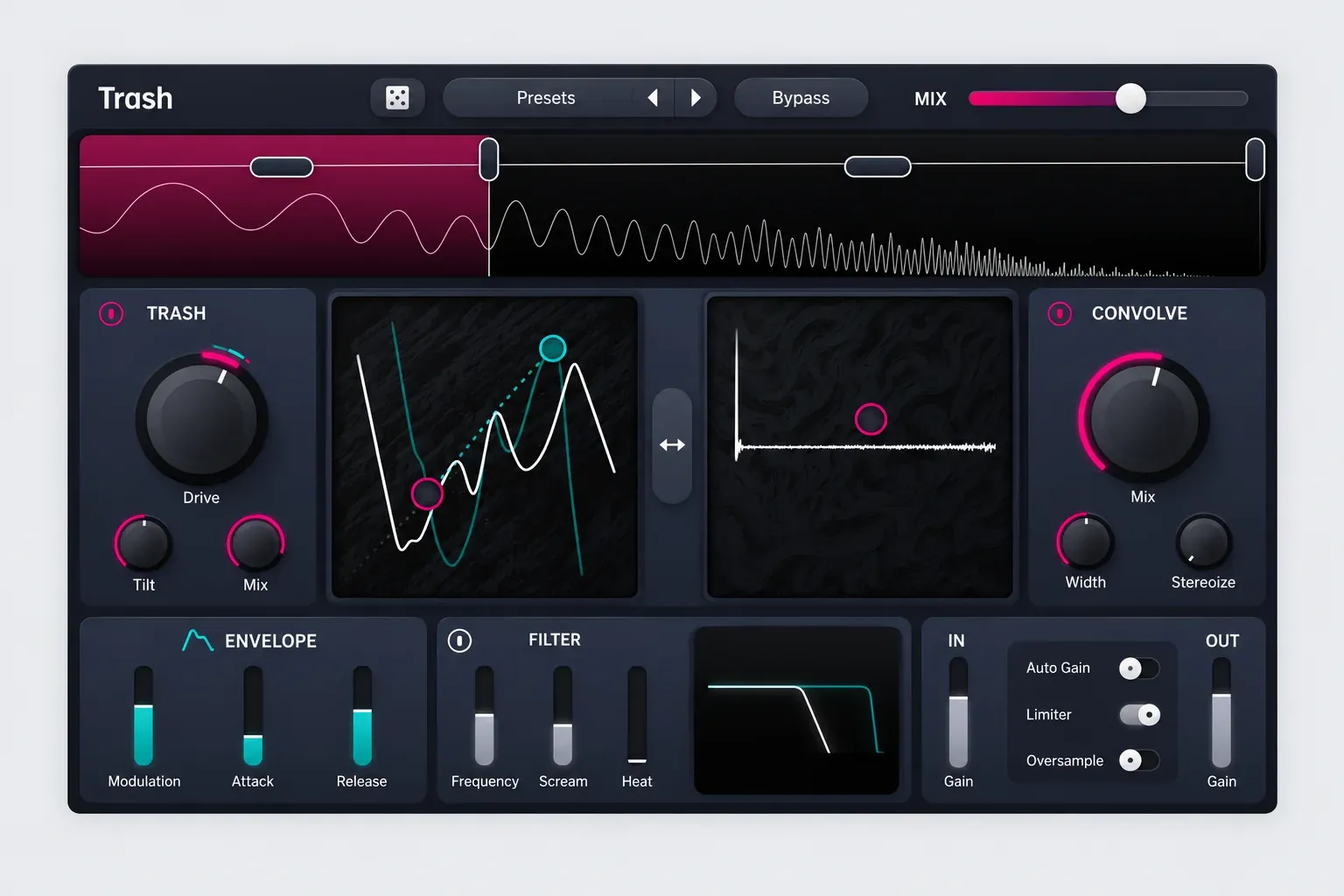
Trash is one window with two sound engines, a Trash module for distortion and a Convolve module for impulse responses, each driven by its own XY pad and split across up to three bands. A Filter, an Envelope follower and an output stage complete the chain.
Trash module
The Trash module's Distortion selector holds 69 distortion types, which iZotope's product page rounds to "60+". Mix lists the categories as Distort, Drive, Faulty, Fuzz, Heavy, Retro and Saturate. Load four types into the corners of the XY pad and the pad's position blends them, with the combined result drawn as a transfer curve. Drive sets the input gain into the module, Tilt shapes the tone before the distortion around an adjustable Tilt Frequency, and Mix blends the module's input and output. Some types add a Style control that varies the character and raises the intensity; it's grayed out on types without one. Randomize, the dice button, fills all four corners with random types at once.
Convolve module
The Convolve module works the same way with impulse responses: up to four on its own XY pad, plus Mix, Width and Stereoize, a Haas-style left/right offset. Many IRs come in Condenser, Dynamic and Ribbon microphone versions, though Mix found the differences much more subtle than expected. The Swap button flips the order of the two modules, so you can distort a convolved sound or convolve a distorted one. On desktop you can also load one custom IR per instance: a mono or stereo file up to one second long, in .wav, .aif, .mp3, .m4a or .flac, at any sample rate.
The library's size depends on who's counting. iZotope's product page promises over 600 impulse responses, the manual says over 300, Mix counted nearly 300 in 14 categories, and MusicTech counted 620 including the condenser, dynamic and ribbon versions of the same sounds. Use the manual's "over 300" as the working figure; the larger counts include microphone variants.
Bands, Envelope, Filter and output
The Multiband display splits the signal into up to three bands, each with its own Trash and Convolve settings. The Envelope section is an envelope follower with Attack and Release that tracks the input and modulates Drive, the XY pad position and the filter cutoff; a Modulation node on the XY pad sets the path that modulation follows. There's no LFO, and Convolve can't be modulated. The Filter is a low-pass with Frequency, Scream for resonance and Heat, which pushes gain into the filter so it saturates. The output stage holds Auto Gain, a Limiter and Oversample, which runs the Trash module at 4x and arrived in version 1.2.0.
Mix's reviewer recommends switching on Auto Gain and the Limiter at high Heat settings to avoid sudden jumps in level and clipping at the output. I'd turn both on before touching Heat at all.
Trash vs Trash 2: what changed
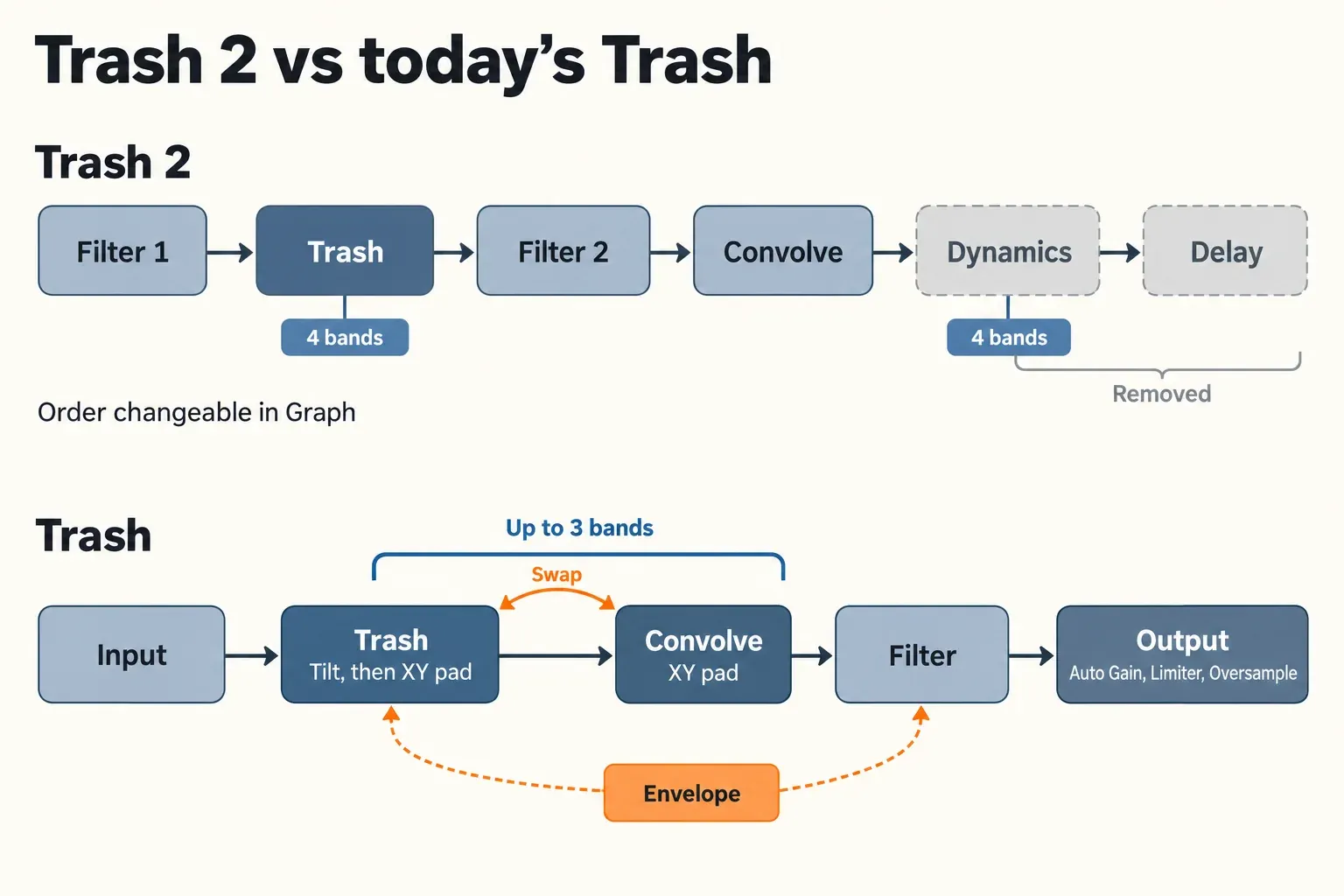
Today's Trash keeps Trash 2's core idea, distortion plus convolution, and drops most of what surrounded it. Mix credits the single-screen design with making navigation easier than Trash 2, which required moving between multiple screens and menus. The table sets the Trash 2 help documentation beside the current manual.
| Feature | Trash 2 (2012) | Trash (2024 onward) |
|---|---|---|
| Modules | Filter 1, Trash, Filter 2, Convolve, Dynamics, Delay | Trash, Convolve, Filter, Envelope, output stage |
| Processing order | Changeable in the Graph view | Fixed, except Swap for Trash and Convolve |
| Bands | Up to 4 in the Trash and Dynamics modules | Up to 3, each with its own Trash and Convolve settings |
| Distortion shaping | User-drawn waveshaper and Dual Stage distortion | 69 types blended four at a time on an XY pad |
| Dynamics | Up to four bands of analog-modeled compression and gating | Auto Gain and a Limiter only |
| Delay | Tape, tape/tube, analog, digital and lo-fi digital | None |
| Sidechain input | Yes, per MusicTech | No, per MusicTech |
| Formats | AAX 64-bit, AU, RTAS 32-bit, VST, VST3 | AAX, AU, VST3, 64-bit only |
| iPad | No | Yes, as an AUv3 |
| Status | Legacy; support ended October 27, 2023 | Current; desktop 1.3.0 |
The gain is speed: one screen, 69 named types instead of curves you draw yourself, and an iPad version, since iZotope calls Trash its first tool released for iPad. The loss is everything around the distortion. All four editorial reviews list the missing Dynamics and Delay modules, and one of the 13 Plugin Boutique buyers calls the new version "a step backward" for being simpler, while still liking the distortion blending. That single 3-star review is the minority view among buyers, but it describes the trade accurately.
Is Trash 2 discontinued?
Yes. Trash 2 is discontinued but still installable for existing owners. iZotope no longer sells it, ended support on October 27, 2023 and stopped testing it against new operating systems and hosts after October 27, 2022. Existing serials keep working, and the installer is still in Product Portal and on the Legacy Downloads page, where the Mac and Windows build is dated December 2, 2022.
Its final spec is frozen: macOS Catalina 10.15.7 to Monterey 12.6, with Apple silicon Macs supported only under Rosetta, Windows 10 or 11, and AAX 64-bit, AU, RTAS 32-bit, VST and VST3 formats. The final host list stops at Ableton Live 10.1–11, Cubase 12, Digital Performer 11, FL Studio 20, Logic Pro, Nuendo 12, Pro Tools 2022, Reaper 6, Reason 11 and Studio One 5. Newer systems can still run it in some cases: Mix's reviewer launched Trash 2 on an M2 Pro Mac in May 2024, without naming the macOS version, and noted that it no longer gets maintenance updates.
Presets are the other loss. iZotope documents no route for importing Trash 2 presets into today's Trash; its preset-transfer article covers one-version-across compatibility for products such as Ozone and Neutron and doesn't mention Trash. A preset built on Dynamics, Delay or a drawn waveshape has nothing to map to in the new plug-in anyway.
My rule for Trash 2 owners is simple. Leave a computer that runs Trash 2 well on its current OS and host versions, and bounce every Trash 2 track you care about to audio before you upgrade either one. If the legacy installer or an old serial refuses to authorize, the Product Portal fixes cover the usual causes.
Price, update and subscription options
For one plug-in, the $99 perpetual license beats a subscription, and the $49 update is the cheapest full route for anyone who owns an earlier Trash. The table lists every way in.
| Option | Price | What it covers |
|---|---|---|
| Trash, full license | $99 (£95 UK, €109 Germany) | Perpetual desktop license, authorized with a serial when you first load it in your host; no trial |
| Update from any previous Trash | $49 (£49, €55) | Owners of an earlier Trash, Trash 2 included |
| Trash EDU | $49.50 (£47.50, €54.50) | Education eligibility required |
| Trash Lite | Free | The Trash module only; a full serial adds the rest |
| iZotope Plus subscription | $15 a month or $150 a year | Includes Trash; 7-day free trial |
| iZotope Pro subscription | $25 a month or $250 a year | Includes Trash; 7-day free trial |
| Everything Bundle | $2,999 | Includes Trash |
| Music Production Suite 9 | $799 | Does not list Trash |
| iPad Trash Upgrade | $19.99 in-app purchase | The iPad plug-in only |
No sale was running in the US, UK or German iZotope stores on that date, and owners of other iZotope products may see a lower price after logging in. Older reviews print older prices: Mix listed $79 with a $29 upgrade for Trash 2 owners, and MusicTech £95 with a £76 introductory price, so go by the current store figures above.
I'd buy the $99 license if Trash is the only iZotope tool you want. A year of iZotope Plus costs $150, a canceled plan turns its tools read-only once it expires, and iZotope itself advises bouncing tracks to audio first. Subscriptions are also serviced by Native Instruments and need a monthly online check in Native Access. A plan makes sense when you'd use the wider catalog too, and iZotope says perpetual licenses remain on sale alongside it.
Bundle buyers should check contents first. Music Production Suite 9 doesn't list Trash in its contents, while the Everything Bundle does, and which iZotope bundle includes what breaks the suites down. For how updates, upgrades and crossgrades are priced across the catalog, see the iZotope upgrade price guide, and current discounts appear on the deals page when there are any.
Desktop and iPad are separate purchases: a desktop license doesn't cover the iPad plug-in. Moving from Lite to full Trash on desktop needs no reinstall, according to iZotope's Trash FAQ: enter the serial in Product Portal, or click Upgrade inside the plug-in and enter it there.
Trash on iPad
On iPad, Trash is a free App Store download with a $19.99 Trash Upgrade in-app purchase. It runs as an AUv3, and iZotope supports only Logic Pro for iPad as its host; other AUv3 hosts may work, but iZotope doesn't guarantee or support them. The App Store build is 1.2.0 from April 20, 2024, which added 4x oversampling, while desktop is on 1.3.0. Custom IRs are desktop-only, and there's no preset browser inside the plug-in; presets come through Logic Pro for iPad's own system. The minimum system is listed two ways: iPadOS 15 on the App Store, iPadOS 17 in iZotope's requirements, so plan on 17. MusicRadar makes its strongest case for Trash on iPad, for Logic Pro for iPad users, and finds the desktop case harder to make. What the free version includes, and how it differs from the full plug-in, is in the Trash Lite guide.
System requirements and hosts
Desktop Trash 1.3.0 runs on macOS Sonoma 14.7, Sequoia 15.7 or Tahoe 26.1, on Intel or Apple silicon Macs natively or under Rosetta, and on Windows 10 or 11. Formats are AAX, AU and VST3, 64-bit only. There's no VST2 version, so a host that loads only VST2 plug-ins won't see it.
iZotope's supported hosts are Logic Pro 10.7–11, Pro Tools 2025, Ableton Live 11–12, Cubase 14, Nuendo 14, Studio One 7, Reaper 7, FL Studio 25, Adobe Audition 2025, Adobe Premiere Pro 2025, DaVinci Resolve 19, Reason 13 and Maschine 3. The Trash release notes list two changes in 1.3.0, released September 25, 2025: a new minimum macOS version and new supported host versions. After installing, you authorize Trash with your serial the first time you load it in one of those hosts.
Who should buy Trash, and who should skip it
Trash suits producers who distort on purpose and decide by ear. Three of the 13 written Plugin Boutique reviews name bass, percussion or heavy electronic music as where it shines, and Mix singles out hip-hop and EDM producers. Sound On Sound expects the redesign to win over people who found Trash 2 intimidating, although two of the 13 buyers still mention a learning curve.
Skip it in three cases:
- You want modulation beyond one envelope follower. There's no LFO, and MusicTech points out that Convolve can't be modulated at all.
- You need several custom impulse responses. Each instance loads one, and Sound On Sound wanted one per XY corner.
- Trash 2's multiband compression and gating or its tape, analog and lo-fi delays were part of your sound. Neither module came back.
For gentle tube color on a bus or a master rather than wreckage, Plasma is the subtler iZotope saturator. And when the distortion is already in your recording and you want it gone, that's a repair job, not a Trash job.
Alternatives to iZotope Trash
My pick if Trash feels too shallow is FabFilter Saturn 2, because it adds exactly what Trash lacks, LFOs and more bands, and you can try it free for 30 days before spending more. MusicRadar names Output Thermal, Arturia's COLDFIRE and Saturn 2 as rivals with more creative depth, and Decapitator covers the analog-saturation end of the job.
| Plug-in | Price | Pick it over Trash when |
|---|---|---|
| FabFilter Saturn 2 | $149 at Plugin Boutique (4.9 from 344 ratings) | You want movement and finer bands: 28 distortion styles, up to 6 bands with optional linear phase, XLFOs, envelope generators and followers in a 50-slot modulation matrix, mid/side processing and a 30-day trial |
| Output Thermal | $149 at Sweetwater | You want one of the rivals MusicRadar rates for more creative depth than Trash |
| Arturia Dist COLDFIRE | $79 at Arturia | You want a cheaper dual-engine distortion with 11 distortion modes and 6 assignable modulation slots, including a syncable LFO, a multi-stage function generator, an envelope follower and a 16-step sequencer; a free demo is available |
| Soundtoys Decapitator | $199 at Soundtoys | You want analog-style saturation rather than destruction: five analog saturation models, a Punish button for extra gain and a modeled tone control |
| Ableton Live or Bitwig Studio devices | Included with the DAW | You already own either; MusicRadar says recent stock plug-ins in both go further than Trash |
The iZotope vs FabFilter comparison puts Trash and Saturn 2 side by side with the rest of both catalogs. For no-cost options beyond Trash Lite, start with the free plug-ins hub.
FAQ
Is there a Trash 3?
No. iZotope sells the 2024 plug-in simply as Trash. An iZotope spokesperson told Mix the company didn't call it Trash 3 because it isn't an update of Trash 2 but a full reimagining, with its code completely rewritten.
Does Trash work in Sound Forge Pro?
Sound Forge Pro isn't on iZotope's supported host list for Trash, so iZotope doesn't support that setup. If Sound Forge is your main editor, install free Trash Lite first and check that it scans and plays as a VST3 before buying the full serial. If it doesn't appear, work through why VST3 plug-ins don't show up in Sound Forge.
Can a Trash update change the sound of old sessions?
It has happened once. Trash 1.1.0, released April 2, 2024, fixed a cross-platform difference in eleven named waveshapes, and the release notes warned that the fix can change the sound of sessions and custom presets that use them, advising you to render critical tracks before updating. I'd render finished Trash tracks to audio before any update for the same reason.
Verdict
My verdict: buy Trash at $99 if you want fast, characterful distortion and convolution for drums, bass and electronic production and you like to decide by ear. Trash 2 owners should pay the $49 update only when their sessions don't depend on Dynamics, Delay, drawn waveshapes or four bands; otherwise keep Trash 2 running and bounce first. If modulation and band count matter more than speed, Saturn 2 is the better $149, and its 30-day trial lets you check that before paying. Start with free Trash Lite either way, and the iZotope hub covers the rest of the catalog.