
True peak is an estimate of the highest level reached by the continuous waveform represented by digital audio. It is reported in dBTP. A sample-peak meter stops at the largest stored sample magnitude; a true-peak meter reconstructs points between those samples and looks for a higher crest.
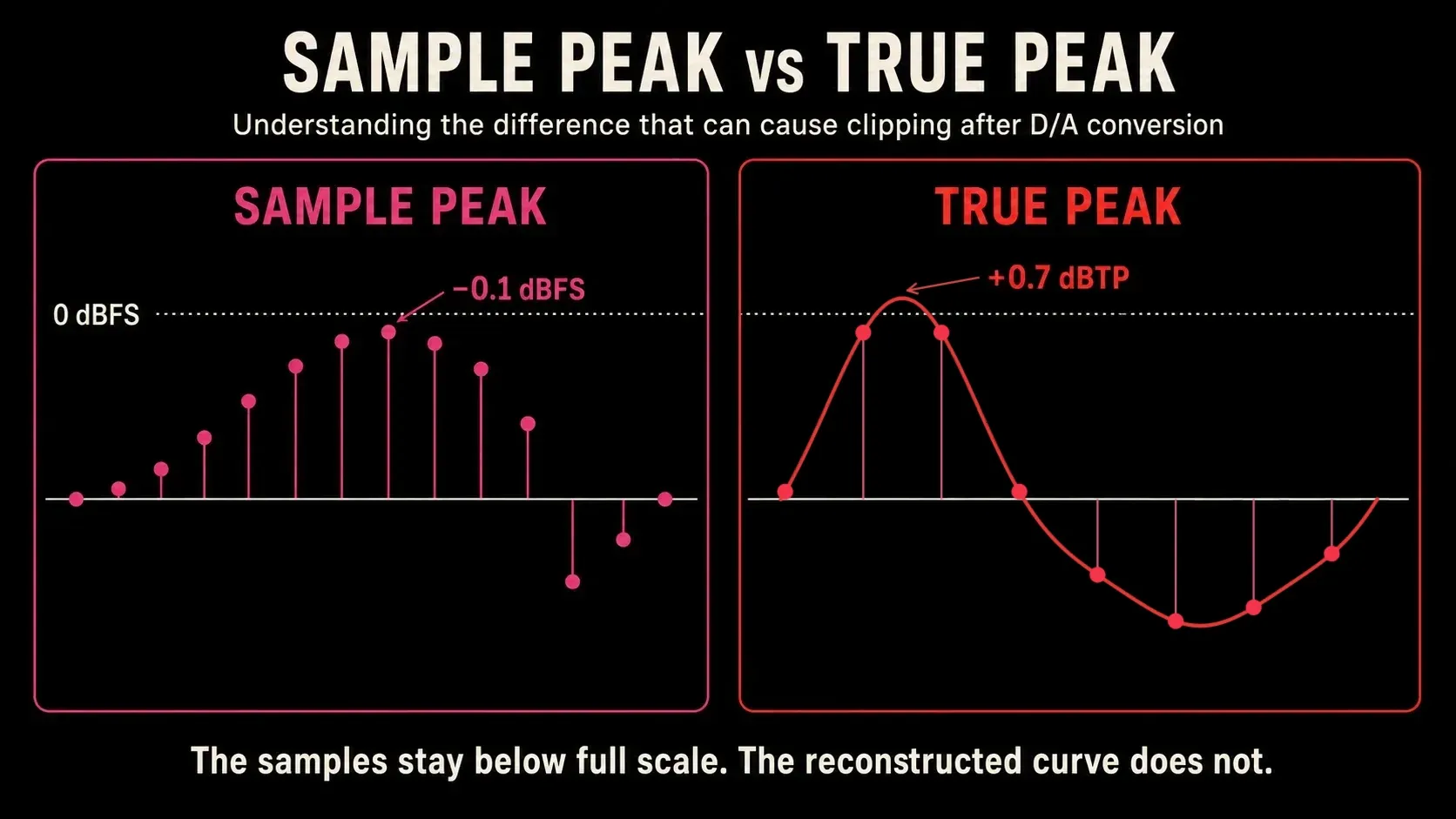
As an illustrative example—not a measurement of a supplied test file—a WAV might have a sample peak of −0.1 dBFS and an estimated true peak of +0.7 dBTP. In this example every stored sample remains below full scale; the overshoot appears between samples in the reconstructed curve. Sample-rate conversion and lossy encoding can change that curve again.
Practical answer: use Integrated LUFS to judge program loudness and true peak to protect the top of the signal. Follow a written delivery ceiling when one exists. Without one, −1 dBTP is a common starting point for lossy delivery, not a law that every platform enforces. Measure the actual encoded deliverable before sending it.
True peak, sample peak and LUFS at a glance
Swipe horizontally to compare every column →
| Measurement | What it reads | Unit | What it answers |
|---|---|---|---|
| Sample peak | Highest stored PCM sample magnitude | dBFS | Did any stored sample reach digital full scale? |
| True peak | Estimated maximum of the reconstructed waveform | dBTP | Could the represented signal crest higher between samples? |
| Integrated loudness | Gated program loudness over the measured duration | LUFS | How loud is the whole program by the chosen measurement standard? |
| Limiter ceiling | A processing control, not a measurement result | dBFS or dBTP, depending on mode | What maximum should the limiter try to hold? |
The units are related to full scale, but they do different jobs. A low true peak doesn’t make dialogue consistently loud, and a correct LUFS result won’t guarantee safe peaks. A limiter set to −1.0 on a sample scale isn’t automatically the same as −1.0 dBTP either.
Why the highest sample can miss the highest crest
PCM audio stores a sequence of sample values taken at discrete moments. Playback doesn’t turn those values into a staircase: ideal bandlimited reconstruction gives a continuous signal through the sample values. A practical DAC and its filter approximate that model; their output depends on the implementation, so not every physical waveform passes exactly through every stored value.
Near a fast transient, the smooth reconstructed curve can rise higher than either neighboring sample. That between-sample maximum is commonly called an inter-sample peak. The sample-peak result remains correct about the data it inspected; it simply answered a narrower question.
ITU-R BS.1770-5 notes that sample-peak under-reading can commonly reach several decibels for transients with significant high-frequency content. It also explains why the problem is generally less severe at higher original sampling rates. Neither statement means every dense master has a huge hidden overshoot. The waveform, sample phase and bandwidth determine the difference.
Floating-point PCM can also store sample values above 0 dBFS; that is a different issue from a between-sample overshoot. A positive dBTP reading describes an estimated peak above the full-scale reference. It doesn’t prove that every converter, phone or streaming path clipped audibly, since downstream headroom and implementation vary. It does tell you the file is close enough to the boundary that reconstruction or later processing deserves attention.
How a true-peak meter makes the estimate
The current BS.1770-5 recommendation specifies a true-peak measurement method built around oversampling. The meter inserts intermediate values, applies an interpolation filter and then searches the higher-rate signal for its maximum. It’s recreating a standards-defined view between the original samples, not recording the output of every possible physical converter.
Oversampling accuracy matters. The ITU document shows that increasing the oversampling ratio reduces the possible under-read. EBU Tech 3343-2023 describes about 0.5 dB of possible under-read for a 4× true-peak meter at a 48 kHz base rate and uses that context when explaining its production headroom.
This is why two meters can disagree slightly without either being a sample-peak meter. They may use different oversampling ratios, filters, channel handling or update behavior. For contractual work, I'd use the meter and mode named by the specification. For ordinary preflight, the useful question is whether the reading leaves comfortable room rather than whether two displays match to the last tenth.
Reconstruction is only the first place peaks can change
A source WAV is not always the file a listener receives. Sample-rate conversion changes the represented samples. AAC, MP3 and other lossy codecs discard and rebuild information according to their own models. Decode filters then create another sample sequence. The loudest point after that path can differ from the source measurement.
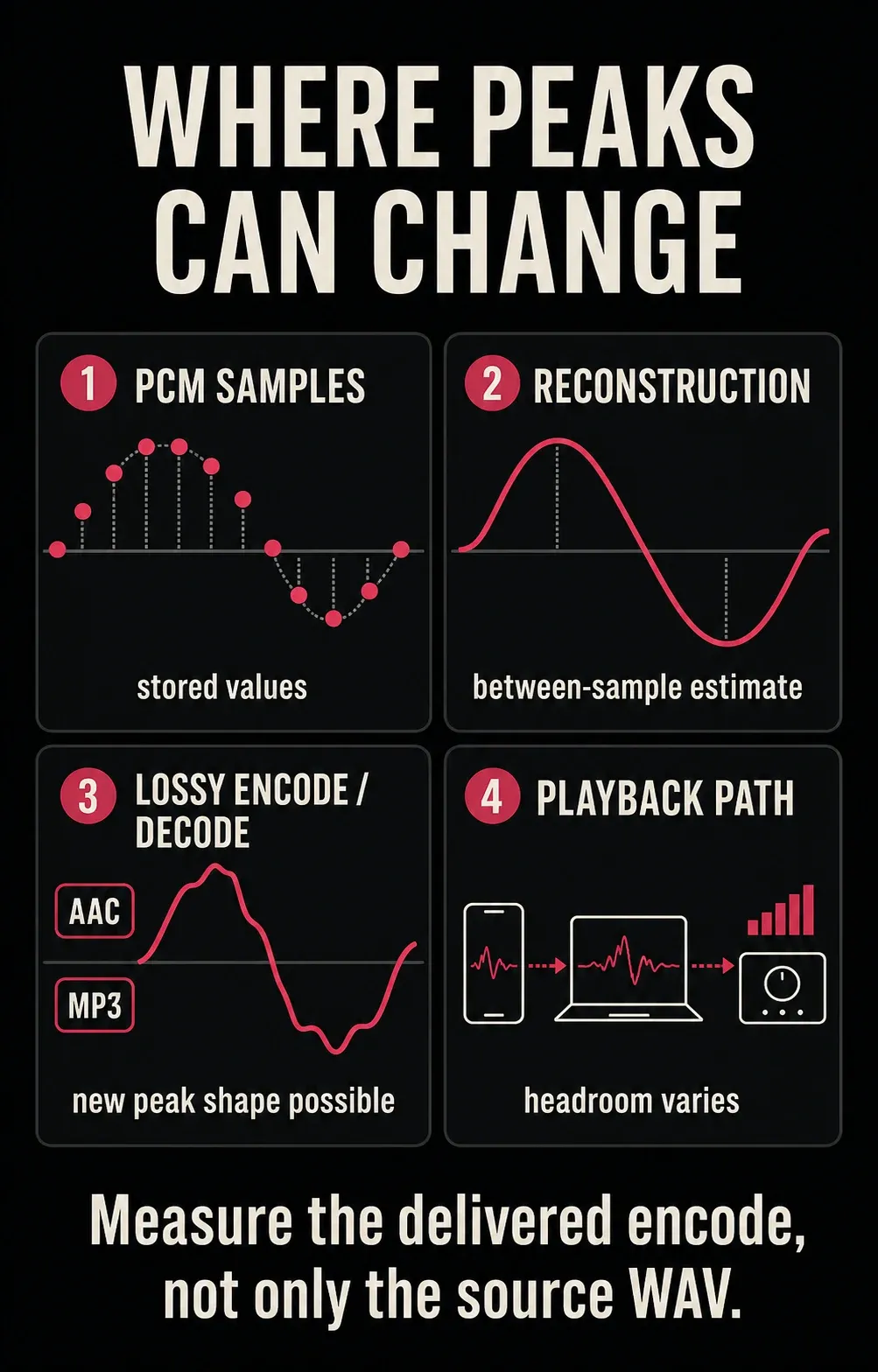
Apple’s Digital Masters technology brief makes the operational point directly: levels that show no overs in PCM can still clip after encoding. Apple supplies tools for auditioning and checking the AAC result and recommends leaving at least 1 dB of headroom in its workflow.
That doesn’t mean every codec always adds one decibel. Content, bitrate, sample-rate conversion and encoder implementation all matter. What it means is that “the source meter was clean” isn’t the final QA result when the deliverable is compressed audio.
What true-peak ceiling should you use?
I'd start with the destination rather than a number copied from a mastering chart.
| Situation | Defensible decision | Scope |
|---|---|---|
| Client or broadcaster supplies a ceiling | Use that ceiling and its named meter/mode | The written specification wins |
| EBU generic linear PCM production | Maximum −1 dBTP | EBU R 128 production context |
| EBU MPEG-1 Layer II or Dolby AC-3 distribution example | Maximum −2 dBTP | Specific data-reduction systems in Tech 3343 |
| Spotify master around −14 LUFS | Keep below −1 dBTP | Current Spotify mastering guidance |
| Spotify master louder than −14 LUFS | Keep below −2 dBTP | Spotify warns louder masters are more vulnerable to encoding distortion |
| No written spec, lossy delivery expected | Use −1 dBTP as a starting point, encode and remeasure | House workflow, not a universal platform rule |
Spotify’s current loudness-normalization guidance is a useful example of scope: it advises below −1 dBTP around −14 LUFS and below −2 dBTP for louder masters. The streaming loudness comparison separates this advice from playback normalization and other delivery specifications. Spotify’s advice does not establish a rejection threshold for Apple, YouTube or another distributor.
True-peak limiting is not the same as typing a lower ceiling
A conventional limiter can hold its output samples below a dBFS ceiling and still produce a higher reconstructed peak. In true-peak mode, a limiter uses an oversampled prediction in its detection path and controls gain against that estimate.
Three practical limits remain:
- The mode must actually be enabled. A plugin may show a true-peak meter while its limiter remains in sample-peak mode. For example, FabFilter Pro-L 2 documents separate True Peak Limiting and TP metering controls; watching the meter is not the same as enabling the limiter mode.
- The source can change after the limiter. EQ, gain, sample-rate conversion or encoding later in the chain can create a new maximum.
- A ceiling is not a sound-quality target. More limiting can reduce transients and raise distortion even when the final dBTP number looks safe.
If a clean master misses a delivery ceiling by a few tenths, I'd lower the final gain or use a controlled true-peak limiter and compare level-matched audio. Lowering gain also lowers integrated loudness, so recheck both the LUFS target and peak ceiling. If the limiter is working hard, revisit upstream processing instead of treating the ceiling as the whole master.
How to measure true peak without confusing it with LUFS
Scan the complete file with an offline meter, or reset a playback meter and run the program from start to finish. Record both Integrated LUFS and maximum true peak. The first number describes program loudness; the second describes the highest estimated reconstructed crest.
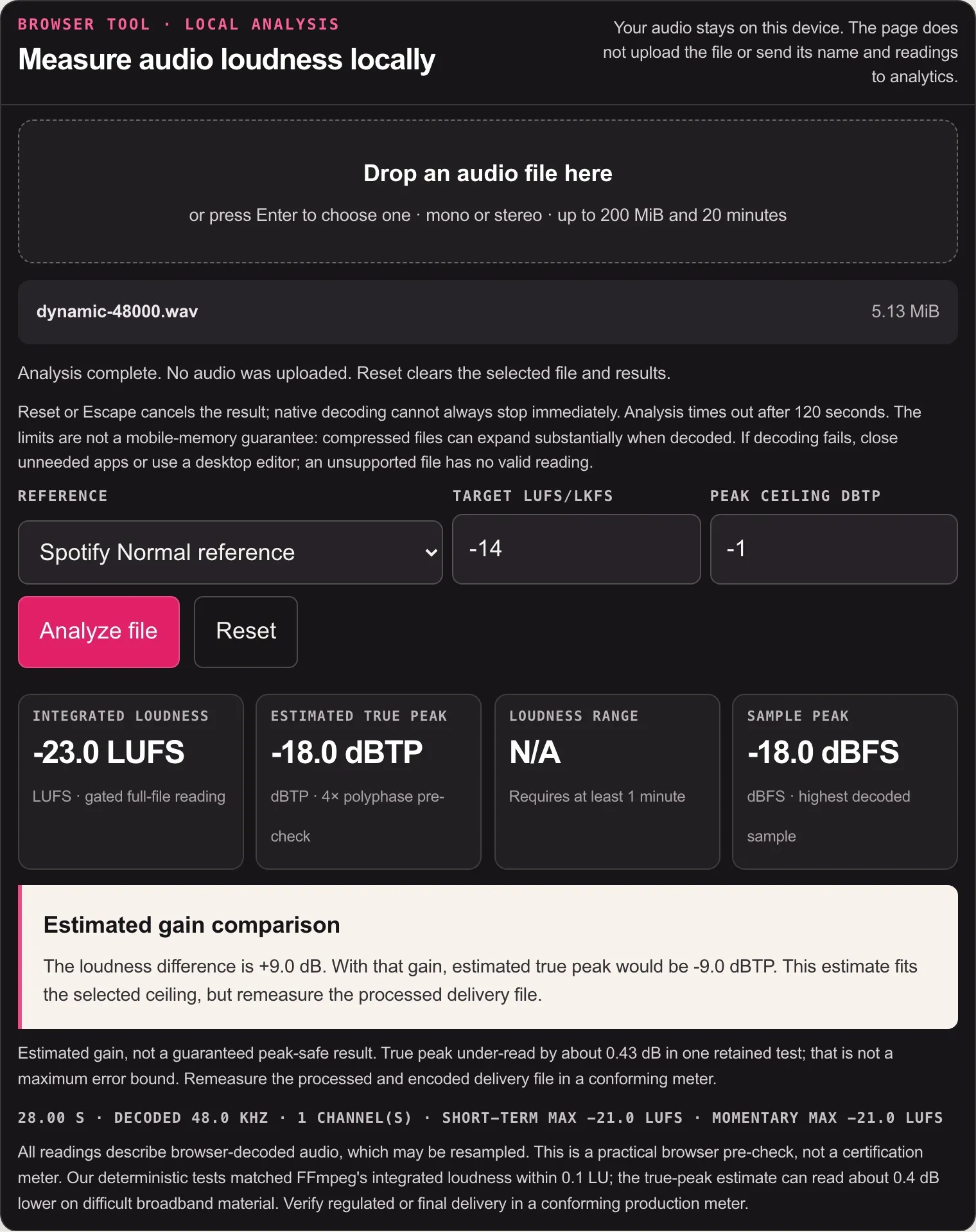
The SoundForgePro browser LUFS meter keeps the audio on the device and reports Estimated True Peak alongside loudness and sample peak. Its current limits are mono or stereo, 20 minutes and 200 MiB per file. Use a whole-file desktop meter for longer or multichannel programs. The browser result is a local pre-check, not a certification. If a broadcaster, client or certification process names a compliant meter, use that specified tool for final acceptance.
For the current Sound Forge interface and meter-reset route, use the Sound Forge LUFS and true-peak guide. If the loudness result itself needs a constant gain correction, the Sound Forge normalization workflow separates Peak, RMS and LUFS decisions.
A five-step true-peak delivery check
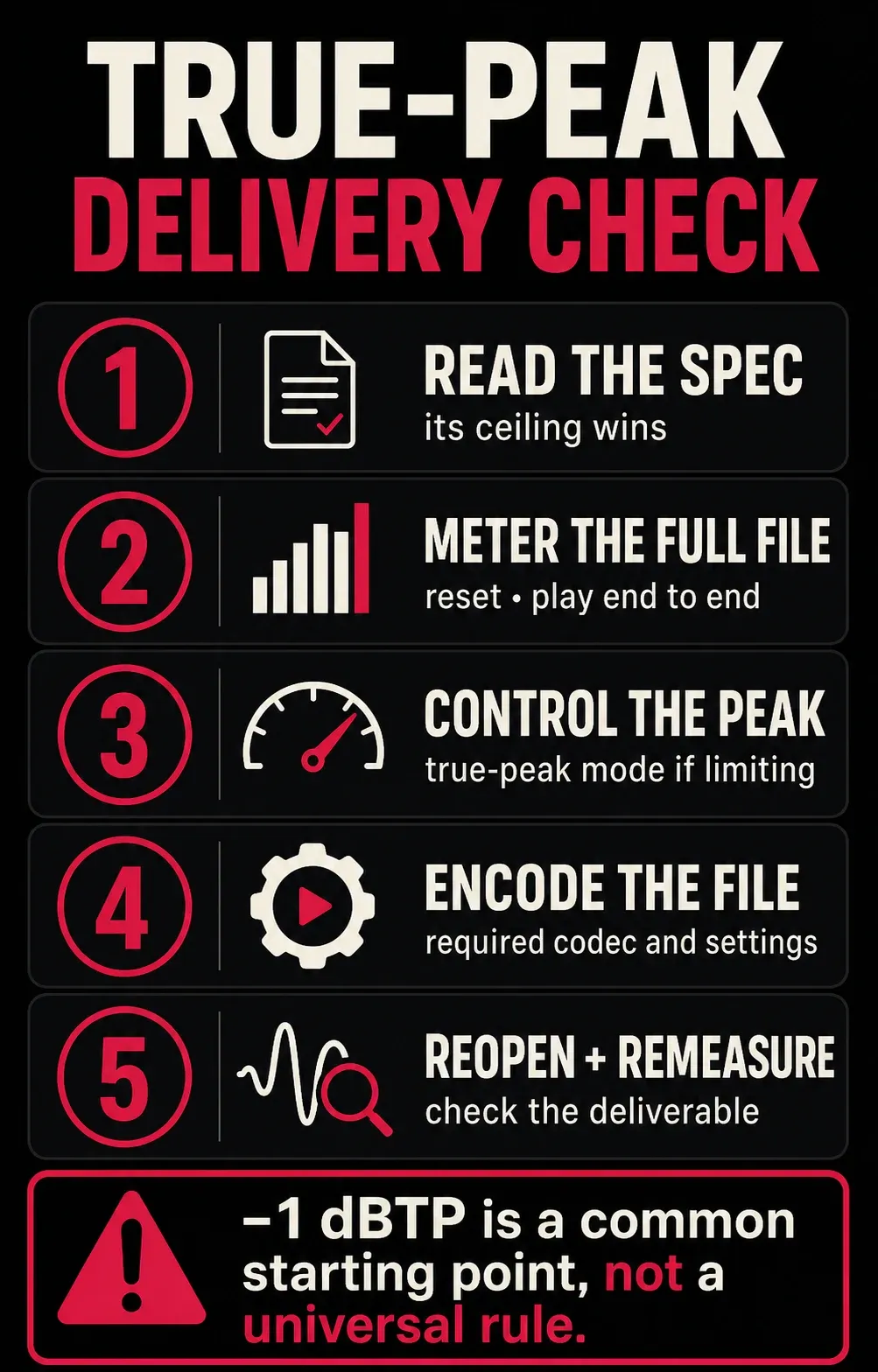
1. Read the written specification
Record the exact ceiling, unit, measurement standard, channel layout and file format. “Peak” is ambiguous unless the brief says sample peak or true peak.
2. Meter the complete program
Scan the complete file offline, or reset a playback meter and play the full program. Save the maximum dBTP result; a short preview can miss the loudest transient.
3. Control the peak deliberately
If correction is needed, reduce gain or use a limiter in verified true-peak mode. Don’t pile on heavy limiting just to make a warning disappear.
4. Encode the delivery file
Create the actual AAC, MP3, video mux or other required deliverable with the specified sample rate and bitrate.
5. Reopen, remeasure and audition
Inspect the delivered file, not only the source session. Listen around the loudest transient and compare the encoded result with the lossless master.
Five mistakes that make true-peak advice unreliable
- Calling dBTP a loudness target. True peak measures the highest reconstructed level; LUFS describes program loudness.
- Calling every reconstructed overshoot audible clipping. A positive estimate flags risk, while the playback path determines the actual outcome.
- Using −1 dBTP as a universal upload rule. It is a common starting point and a real value in specific standards, but scope matters.
- Checking only the source WAV. The codec or sample-rate conversion can create a different peak shape.
- Assuming the limiter guarantees the deliverable. Processing after the limiter and the final encode still need verification.
True peak FAQ
Can true peak be above 0 dBTP when no sample clips?
Yes. Every stored sample can remain below 0 dBFS while the reconstructed waveform rises above full scale between samples. A true-peak meter estimates that crest by oversampling and interpolation.
What is the difference between dBTP and dBFS?
dBFS is the full-scale reference commonly used for stored digital sample levels. dBTP uses the same full-scale reference for a true-peak measurement that accounts for between-sample reconstruction.
Is −1 dBTP the correct ceiling for every platform?
No. −1 dBTP is a common starting point and an EBU limit for generic linear PCM production, while other delivery systems or platform guidance can specify a different ceiling. Follow the written destination requirement.
Does true peak affect LUFS?
They describe different properties. Changing gain or limiting can affect both results, but a true-peak number does not tell you the program's Integrated LUFS, and a LUFS result does not reveal its maximum reconstructed peak.
Does a true-peak limiter guarantee that AAC or MP3 will not clip?
No. It reduces risk at the limiter output, but later sample-rate conversion and encoding can change peak shape. Encode the required format, reopen it and measure the deliverable.
How do I measure true peak correctly?
Use a true-peak meter to scan the complete file offline, or reset it and play the full program. Record the maximum dBTP value. For formal delivery, use the standard, meter and mode named by the specification; then repeat the check on the encoded file.
Check true peak on the final encoded file; a sample-peak ceiling alone does not account for peaks between samples.