
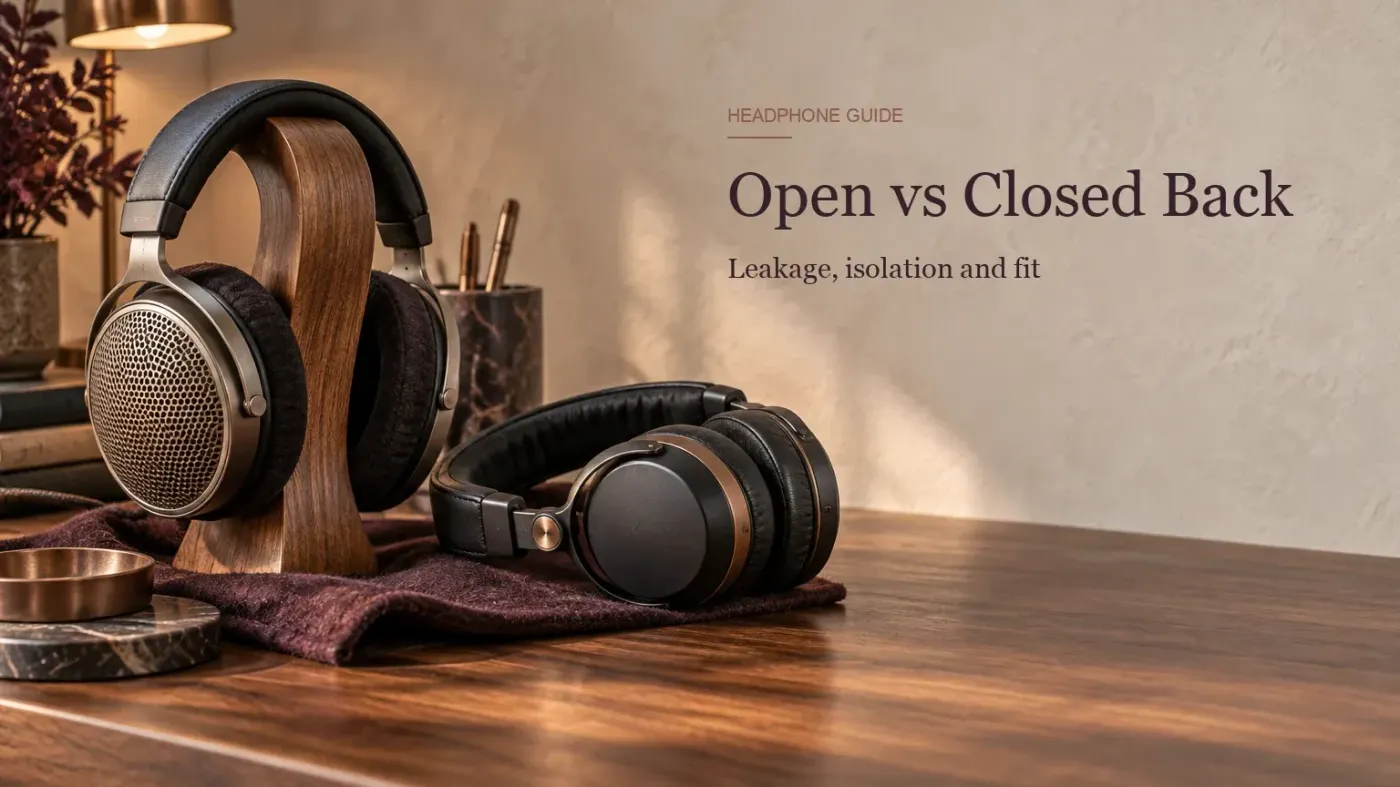
Choose closed-back headphones when you record near a microphone, work around other people or need to keep outside noise down. Choose open-back headphones for listening and editing in a quiet room when sound leaking out will not bother anyone. For mixing, the back of the earcup is only a starting point: the response, fit and consistency of the actual headphone matter more than the category name.
- Recording a vocal or instrument? Start with closed-back to reduce cue or click bleed into the microphone.
- Working in a quiet room without an open mic? Open-back is worth considering if you prefer its less isolated presentation.
- Sharing a room, commuting or working around noise? Closed-back is usually the practical choice.
What open-back and closed-back actually mean
The terms describe the outer housing behind the headphone driver. An open-back earcup has an acoustically transparent area, such as a grille or perforations, so sound can pass between the cup and the room. A closed-back earcup uses a solid outer housing to reduce that exchange. Beyerdynamic's explanation of the two designs makes the important practical point: open cups admit room sound and let playback escape, while closed cups are built to limit both.
Those labels don't describe the whole headphone. Pads, clamp force, glasses, hair and how the cup sits around your ear all affect the seal. Even a closed model can leak at a high playback level or isolate poorly if it doesn't fit you. RTINGS shows that leakage and isolation vary between individual models, including closed models. Treat the construction as a useful expectation, then check the actual pair.
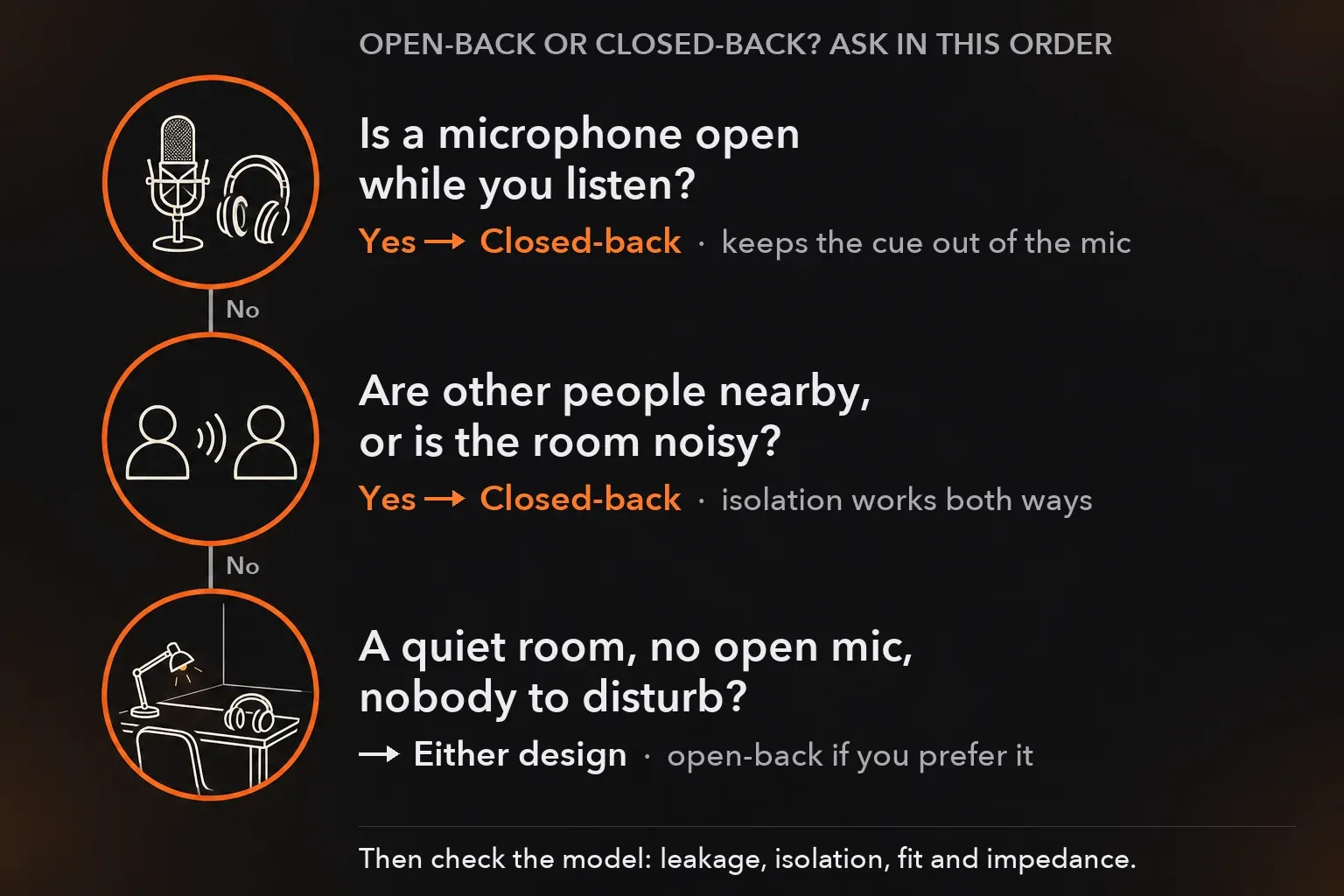
Once you're past the labels, the choice comes down to three questions about where you listen, asked in this order.
The differences that change your decision
| What matters | Open-back | Closed-back |
|---|---|---|
| Sound heard by others | More playback can escape into the room. | Usually less leakage, depending on fit and level. |
| Room noise you hear | Little passive isolation; you remain aware of the room. | More passive isolation when the pads seal well. |
| Near a live microphone | Cue sound may reach the mic. | Usually the safer monitoring choice, but not bleed-proof. |
| Quiet, private listening | Often preferred for a less enclosed presentation. | Still viable; the exact model decides sound quality. |
| Long sessions | Ventilation may help with heat. | May feel warmer, though pads, weight and clamp matter more to some people. |
| Travel and handling | Often an indoor design: exposed grilles, non-folding frames and long cables are common. | More often built to fold or travel, though build still varies by model. |
| Laptop or phone output | Check impedance and sensitivity before relying on a weak output. | Often lower impedance and easier to drive without a separate amplifier. |
Passive isolation is the physical reduction of outside sound by the earcup and seal. Active noise cancellation is a separate electronic feature found on some headphones. A closed-back label alone doesn't promise ANC, and ANC doesn't tell you whether the headphone is suitable for recording or mixing. Passive isolation also affects how loud you listen: the RTINGS explainer linked above notes that it lets you hear music or game audio without cranking the volume, because less outside noise competes with it.
The same explainer flags two differences that have nothing to do with sound. Open-back models are usually meant for indoor use, so exposed grilles, lighter materials, non-folding frames and long cables are common. RTINGS adds that the lighter build can make them more fragile and poorly suited to rough handling or travel. Closed-back models often have lower impedance, which makes them easier to drive without a dedicated headphone amplifier. RTINGS names exceptions both ways, including the closed FiiO FT1, built with audiophiles rather than commuters in mind, and the open Sennheiser HD 650, a well-built design that has stood the test of time. Check the build, cable and impedance of the model itself.
For recording, keep the cue out of the microphone
A singer or instrumentalist often hears a click, guide track or previous takes while the microphone remains open. Open-back cups let some of that playback into the room, where the mic can pick it up. Closed-back cups reduce that risk, which is why Shure recommends closed-back headphones for tracking. Neumann likewise positions its closed-back NDH 20 for monitoring in a tracking room.
Closed-back doesn't mean zero bleed. Keep the cue at a workable level, check the pad seal, and consider where the microphone points. If the headphone mix contains a loud click, a short test recording can tell you whether it's audible in the mic signal. The Sound Forge Pro recording walkthrough covers arming, metering and input monitoring for that kind of test take. That's a check on your recording setup, not a reason to buy a different pair before you know the problem.
If you're recording an acoustic source but there's no headphone playback near the open mic, leakage may not matter. The decision depends on the actual monitoring path, not just the word recording.
Streaming, podcasting and voice chat put the same trade-off in a different room. Sweetwater's open-back vs closed-back guide suggests closed-back when you stream with noisy roommates or need to stay focused, and open-back when you want to hear what's happening around you and keep your own voice at a reasonable level. RTINGS adds the catch for anyone on a live microphone: an open pair leaks sound that the mic can pick up, which is why it points to closed models such as the Sony MDR-7506 for recording, tracking and broadcasting. If you choose closed-back and still want to hear your voice naturally, send a little of the microphone into the headphones. The voice-over recording guide explains how the driver choice affects the delay before you hear that monitored voice. For gaming itself, RTINGS finds both designs workable: an open-back headset's wider sound field can help you place sounds, while competitive players often prefer closed-back models that block distractions around cues such as footsteps.
For mixing, judge the model rather than the back
Open-back designs are often liked for a spacious, less closed-in presentation in a quiet room. Neumann positions its open-back NDH 30 for editing, mixing and mastering. That doesn't mean an arbitrary open-back headphone has a neutral response or will make better mix decisions.
Closed-back models can also be designed for critical work: Neumann explicitly includes mixing among the NDH 20's uses. The two models illustrate the limit of a category rule. A headphone's tuning, distortion, pad condition, seal and your working environment affect what you hear. The enclosure can influence presentation, but it isn't an accuracy certificate.
If you mix in a quiet room, an open pair can be a sensible option. If the room is noisy or someone else is nearby, isolation may be more valuable than a wider-feeling presentation. In either case, keep a few familiar references and check important decisions on another playback system when possible. Headphones are one listening view, not a guarantee that a mix will translate everywhere.
If you can buy only one pair
Choose for the constraint you can't work around. If you record vocals, track instruments with a click, travel or share a room, I'd start with a well-fitting closed-back pair. It handles those settings and can still be used for editing and mixing if the particular model gives you a response you can learn. A quiet-room listener who never tracks with an open mic can reasonably choose open-back instead.
If you later use two pairs, give each a job: closed-back for tracking and noisy settings, open-back for quiet-room listening if you prefer its presentation. That's a workflow choice, not a rule that every studio needs two pairs. A producer choosing specific headphones for Ableton Live can use the Ableton Live headphone guide for model and connection decisions. This comparison is about construction across applications.
What about comfort, bass and soundstage?
Open cups can allow more airflow, so some listeners find them cooler over a long session. Closed cups can feel warmer, but the pad material, weight and clamp can outweigh the housing difference. RTINGS treats these comfort differences as general tendencies, not a promise about every pair. The useful comfort check is the actual fit on your head for the kind of session you do.
Open-back is often described as more spacious, while closed-back can feel more intimate. Those are common listening impressions, not promises about every model. Bass is even less safe to predict from the enclosure alone: a poor seal can reduce low frequencies on a closed pair, and a well-designed open pair can have controlled bass. If tonal accuracy matters, compare measurements and listening evidence for the model you're considering instead of assuming one construction always has more or better bass.
Does semi-open solve both problems?
Not automatically. Semi-open is a loose category for designs between fully open and fully closed. Beyerdynamic notes that its semi-open models behave more like open models. Another manufacturer's semi-open model may behave differently. Check its leakage and isolation rather than assuming it splits the difference exactly in half.
Three checks before you decide
- Name the room and task. Is a mic open? Are other people close enough to hear your playback? Is outside noise likely to mask quiet details?
- Check the specific model. Look for independent leakage, isolation and response information. Note the pad material and whether a good seal is likely with glasses or your usual fit.
- Keep the next task separate. Construction tells you how a pair interacts with the room. Once you own it, our headphone test can help check channels, rattles and sweep anomalies; it does not measure the headphone's frequency response.
For most readers, the decision is straightforward once the setting is clear: closed-back when privacy, isolation or microphone bleed matters; open-back when the room is quiet and leakage is acceptable. The model still has to earn its place on your head and in your work.